
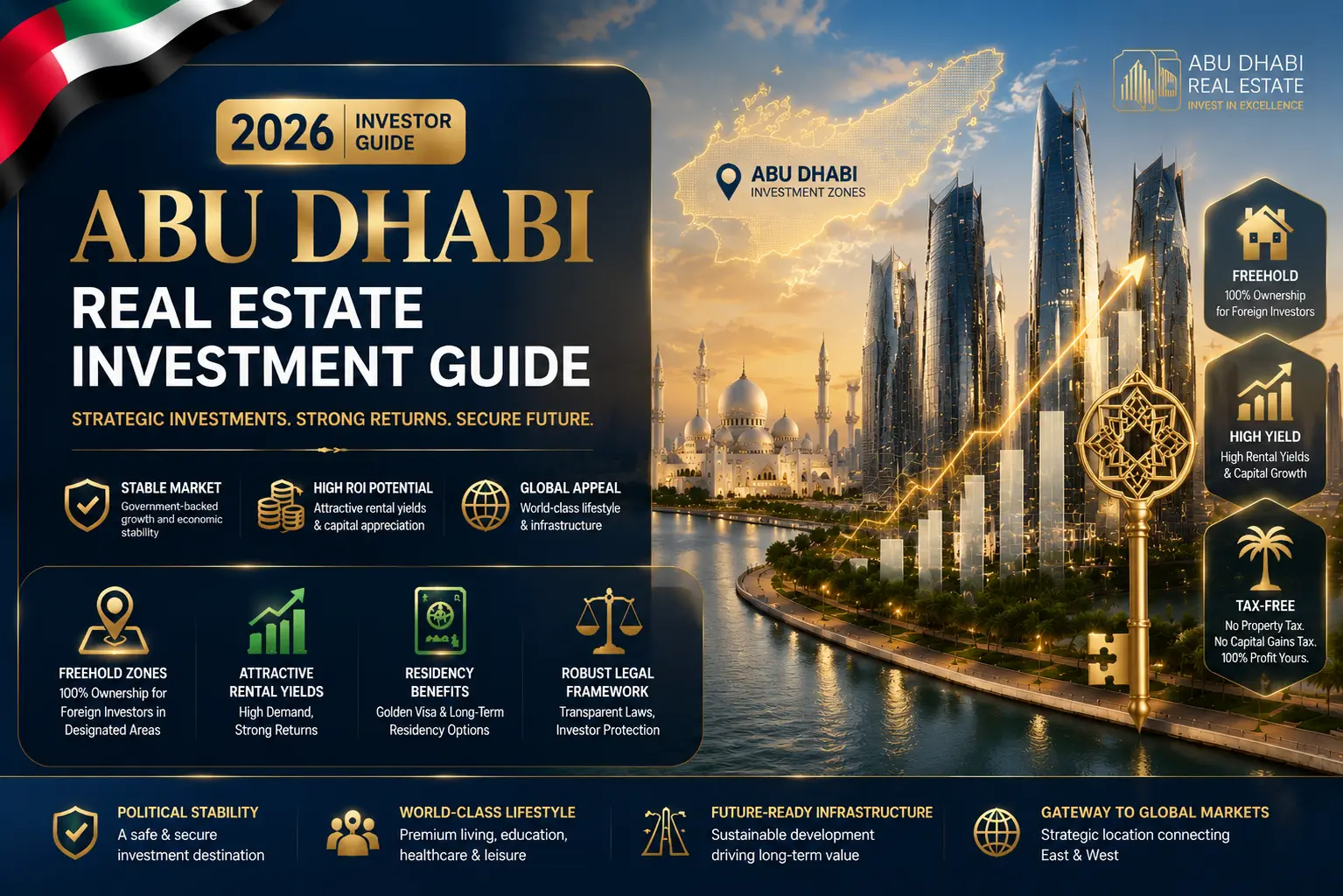
Abu Dhabi is the quieter cousin in the UAE property story, and increasingly the smarter one. While Dubai dominates headlines, the capital has spent a decade building a high-density, high-quality investment market on a small number of designated islands and master plans. The result is a market with lower density than Dubai, stronger institutional backing through Mubadala and ADQ, and a direct line into the UAE Golden Visa programme. This guide walks through what foreigners can buy, where they can buy it, what it costs, and how a property purchase converts into a 10-year residency.
Can foreigners buy property in Abu Dhabi?
Yes, but with a critical caveat: foreign nationals can only buy freehold property in nine designated "investment zones" defined by Abu Dhabi Law No. 13 of 2019 and subsequent amendments. Outside those zones, foreigners are limited to long-term leasehold or usufruct rights of up to 99 years, which carry similar economic value but do not transfer the underlying land.
The current freehold zones for foreign ownership are Saadiyat Island, Yas Island, Reem Island, Al Raha Beach, Al Reef, Lulu Island, Al Maryah Island, Masdar City, and Hidd Al Saadiyat. These cover almost every premium development a foreign investor would seriously consider, including the cultural districts around the Louvre Abu Dhabi, the marina apartments on Yas, and the family villas of Al Reef. Buying inside an investment zone gives you a freehold title deed registered with the Department of Municipalities and Transport, transferable, mortgageable, and inheritable.
Abu Dhabi real estate laws: what foreign buyers need to know
Abu Dhabi's foreign ownership framework is governed primarily by Law No. 19 of 2005, amended by Law No. 13 of 2019, which expanded freehold rights to all nationalities (previously only GCC citizens held true freehold). The conveyancing process is overseen by the Abu Dhabi Department of Municipalities and Transport (DMT) and registered through the Abu Dhabi Real Estate Centre.
Key legal points buyers should understand:
- Freehold title. Inside the nine designated zones, foreigners receive full ownership of both the unit and the underlying land, indistinguishable from Emirati ownership rights.
- Usufruct and musataha. Outside investment zones, foreigners may hold usufruct (use rights) up to 99 years or musataha (long lease with build rights) up to 50 years renewable.
- No restrictions on number of properties. Foreign individuals can own unlimited properties in their own name across the investment zones.
- Inheritance follows UAE Civil Code by default. Foreign owners are strongly advised to register a DIFC or ADGM will to override Sharia-based intestate succession on UAE-situs assets.
- Off-plan protections. Developer escrow accounts are mandatory for off-plan sales under Abu Dhabi escrow regulations, protecting buyer deposits until construction milestones are met.
Abu Dhabi real estate prices in 2026
Abu Dhabi prices remain meaningfully below Dubai for equivalent quality, particularly in the ultra-prime cultural district of Saadiyat Island. The table below summarises typical 2026 entry points across the most popular foreign-buyer zones.
| Zone | Asset class | Typical entry (AED) |
|---|---|---|
| Al Reef | Family villa | 1.4M to 2.5M |
| Reem Island | 1-bed apartment | 800K to 1.4M |
| Yas Island | 2-bed apartment | 1.6M to 2.8M |
| Al Raha Beach | 3-bed apartment | 2.2M to 4.0M |
| Saadiyat (Mamsha, Saadiyat Lagoons) | Branded apartment | 2.5M to 6M+ |
| Saadiyat Beach Villas | 4-bed beachfront | 9M to 25M+ |
| Al Maryah Island | Branded residence | 3M to 12M+ |
Off-plan launches throughout 2025 and into 2026 from Aldar Properties (the dominant local developer), Modon, IMKAN, and Bloom Holding have kept supply meaningful, though pricing on premium beachfront product like Saadiyat Lagoons and Hudayriyat Island has appreciated 20 to 35% over the past three years. Secondary-market apartments on Reem and Yas remain among the best value-per-square-foot waterfront options anywhere in the GCC.
The Golden Visa link: AED 2 million unlocks 10 years
This is where Abu Dhabi property turns into something more than an asset purchase. Under UAE Federal Law, a property valued at AED 2 million or more (around USD 545,000) qualifies the foreign owner for a 10-year renewable Golden Visa. The property can be a single unit or aggregated across multiple units to reach the threshold, must be fully owned (not leased), and may be either off-plan from a registered developer or completed.
From February 2026, the previous 50% upfront payment requirement on mortgaged or off-plan property was eliminated, opening the Golden Visa route to buyers using developer payment plans from day one. This is a significant change. Previously, buyers needed at least AED 1 million in equity at the moment of application; now the title-deed value alone qualifies, regardless of mortgage status.
A secondary, less common route exists under the retirement programme: the UAE 5-year retirement visa (age 55+) accepts AED 1 million in real estate OR AED 1 million held in savings (3-year UAE bank fixed deposit) OR monthly income of AED 20,000 (AED 15,000 in Dubai). For everyone else, the AED 2 million / 10-year route is the realistic pathway.
Tax-free returns: why the numbers actually work
The investment case for Abu Dhabi property rests on a simple tax structure. UAE residents pay 0% personal income tax, no capital gains tax, no inheritance tax, and no annual property tax. The only meaningful headline cost is a one-time transfer fee paid to the DMT (typically 2% of purchase price in Abu Dhabi, lower than Dubai's 4% Land Department fee), plus standard agency, legal, and trustee fees.
That tax framework changes the underwriting maths. A Saadiyat apartment generating AED 200,000 per year in gross rent, after 25% in service charges and management fees, returns roughly AED 150,000 net to the owner. In London, Paris, or New York, a property at the same gross yield would surrender 30 to 45% of net rent to income tax. In Abu Dhabi, that AED 150,000 lands in the owner's account intact.
VAT applies at 5% only on commercial property and on certain off-plan transactions; residential resale is generally VAT-exempt. Corporate tax of 9% on profits above AED 375,000 (around USD 102,000) was introduced in 2023, but applies only to business activity, not personal rental income held in an individual name.
Abu Dhabi real estate for rent: what tenants pay and what owners net
The rental market in Abu Dhabi is structurally different from Dubai. Tenants are dominated by long-term residents working in government, energy, finance, and the cultural sector, with shorter holiday-let inventory concentrated mainly on Yas Island near the theme parks. Annual leases remain the norm, with rent typically paid in 1, 2, or 4 cheques, although monthly payment plans are increasingly available on prime stock.
Indicative gross rental yields in 2026 are running:
- Reem Island apartments: 6.5% to 8% gross
- Yas Island apartments: 6% to 7.5% gross
- Saadiyat apartments: 5% to 6.5% gross
- Al Reef villas: 5.5% to 7% gross
- Saadiyat villas (luxury): 4% to 5.5% gross
- Al Raha Beach apartments: 5.5% to 6.5% gross
Net yields after service charges (typically AED 15 to 25 per square foot per year), property management (5 to 8% of rent), and routine maintenance usually land around 4 to 6.5% net. Combined with the zero-tax wrapper, that compares favourably to almost any tier-1 global city, where comparable assets net 1.5 to 3% post-tax.
Abu Dhabi vs Dubai: the luxury alternative case
Dubai has more deals, more transactions, and more global mindshare. Abu Dhabi has lower density, stronger sovereign backing, and a different buyer profile. For investors weighing the two, the trade-offs are real:
| Factor | Abu Dhabi | Dubai |
|---|---|---|
| Transfer fee | ~2% (DMT) | 4% (DLD) |
| Foreign freehold zones | 9 designated investment zones | ~30 designated freehold areas |
| Density | Lower, master-planned islands | Higher, urban density |
| Primary buyer | Long-term residents, GCC nationals, institutions | Global retail, short-term let investors |
| Sovereign backing | Direct via Mubadala, ADQ, Aldar | Indirect via developers and DLD |
| Annual price volatility | Lower | Higher |
| Short-term let market | Limited (Yas, Saadiyat) | Mature, regulated |
| Golden Visa threshold | AED 2M | AED 2M |
The clearest case for Abu Dhabi is for buyers who prioritise long-term capital preservation, lower-volatility cashflow, and lifestyle quality on lower-density islands. The clearest case for Dubai is for buyers who want short-term let income, faster transaction velocity, and exposure to retail-investor inflows. Many sophisticated GCC investors hold both, treating Abu Dhabi as the core and Dubai as the trading book.
Buying process: step-by-step for foreign investors
The Abu Dhabi conveyancing process is relatively quick by global standards, typically completing in 30 to 60 days for ready property and tied to construction milestones for off-plan. The standard sequence:
- Reservation and MoU. Sign a Memorandum of Understanding (Form A) with the seller, accompanied by a 10% deposit held by the broker or trustee.
- NOC from developer. The seller obtains a No Objection Certificate from the master developer confirming all service charges are clear. Usually 1 to 2 weeks.
- Mortgage approval (if applicable). Local banks lend up to 75% LTV to UAE residents and 50 to 65% to non-residents. Approval typically 2 to 4 weeks.
- Transfer at DMT. Both parties attend the trustee office. The buyer pays the balance, the 2% transfer fee, and admin charges. The new title deed is issued the same day or within 48 hours.
- Golden Visa application. Once the title deed is in hand, a Golden Visa application can be filed through ICP or a registered typing centre. Approval typically issued within 2 to 4 weeks.
For off-plan, payments follow the developer's milestone schedule (usually 10% on booking, 30 to 50% during construction, 40 to 60% on handover). Title and Golden Visa eligibility crystallise at handover.
Choosing the right Abu Dhabi address, structuring the purchase for Golden Visa qualification, and aligning the asset with your long-term tax residency requires hands-on advice. Golden Keys Global has placed clients into Saadiyat, Yas, Al Raha, and Reem since the freehold framework opened.
Where the smart money is buying in 2026
Three Abu Dhabi sub-markets are seeing the strongest institutional and family-office interest right now:
Saadiyat Cultural District. Branded residences anchored to the Louvre, Guggenheim Abu Dhabi (opening 2026), and Zayed National Museum command premium pricing but offer the strongest long-term capital story in the country. New launches by Aldar and Modon include luxury apartments and beachfront villas that consistently sell out in the first release window.
Yas Island. The leisure island anchored by Ferrari World, Warner Bros, Yas Marina Circuit, and Yas Bay continues to expand. Apartment yields here are among the highest in the city, supported by tourism-linked short-term lets where regulations permit. Yas Acres villas have become a sought-after family product.
Al Maryah and Al Reem. The financial district anchored by ADGM (the Abu Dhabi Global Market) and the wider Reem master plan is positioned as the city's CBD. Branded residences (Four Seasons, Edition, Mandarin Oriental pipeline) offer strong rental demand from finance professionals and serviced-apartment operators.