
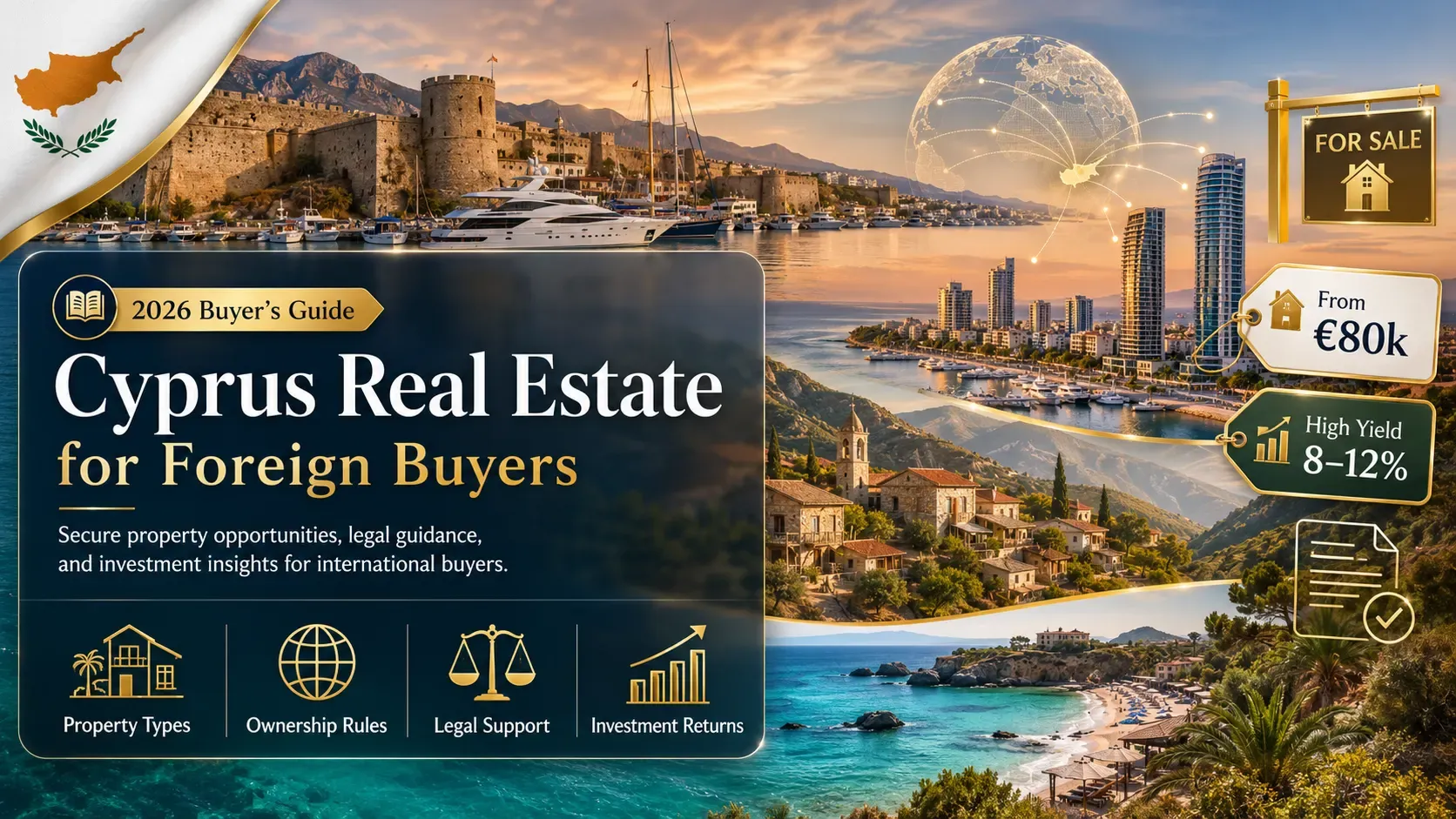
Cyprus real estate for sale starts at roughly EUR 1,800 per square metre in Nicosia and rises to EUR 8,000 in beachfront Limassol. Foreign buyers who invest EUR 300,000 or more in a residential property qualify for the Cyprus Permanent Residency programme (Category 6.2 fast-track), with processing in around six months. VAT is 5% on a primary residence's first 130 sqm (with further price and size caps — see below), 19% otherwise.
Why foreign investors are buying Cyprus real estate in 2026
Cyprus combines EU membership, English-language administration, a 12.5% corporate tax rate, and a Permanent Residency-by-Investment route tied directly to property ownership. For a single EUR 300,000 residential purchase, the buyer, spouse, and dependent children secure lifetime PR with a route to citizenship after eight years.
The island's appeal is structural, not seasonal. Cyprus operates one of the lowest corporate tax rates in the European Union, abolished annual property tax in 2017, and offers a non-domiciled regime that exempts dividends, interest, and rental income from tax for 17 years. For a high-net-worth family relocating from the UK, Lebanon, Israel, or the Gulf, the maths is straightforward: a property purchase doubles as a residency vehicle and a tax-efficient base inside the EU.
The market itself is segmented. Limassol commands premium prices driven by international demand and corporate relocations. Paphos suits retirees and lifestyle buyers. Larnaca is the emerging value play around the new marina and airport hub. Nicosia, the capital, anchors the long-term-rental market. Each city tells a different investment story, and the right answer depends on whether the buyer wants yield, lifestyle, or capital growth.
Cyprus property prices by city: Limassol, Paphos, Larnaca, Nicosia
Pricing varies sharply across the four main markets. Limassol leads with new-build apartments at EUR 4,500 to 8,000 per square metre, reflecting the city's role as the island's commercial and luxury hub. Paphos sits at EUR 2,500 to 4,500 per sqm, Larnaca at EUR 2,000 to 3,500, and Nicosia at EUR 1,800 to 3,200.
| City | Price per sqm (EUR) | Buyer profile | Strength |
|---|---|---|---|
| Limassol | 4,500 - 8,000 | HNW, corporate, beachfront | Capital growth + prestige |
| Paphos | 2,500 - 4,500 | Retirees, lifestyle | Affordability + quality of life |
| Larnaca | 2,000 - 3,500 | Value investors | Marina + airport upside |
| Nicosia | 1,800 - 3,200 | Long-term rental | Capital city yield |
Beachfront premiums in Limassol can push completed apartments above the EUR 8,000 ceiling, particularly along the Limassol Marina and the Amathus Bay corridor. Buyers chasing the EUR 300,000 PR threshold tend to find the cleanest options in Paphos and Larnaca, where new-build two-bedroom apartments routinely hit the threshold without overpaying. Nicosia is the contrarian pick: lower prices, stable rental demand from professionals and government workers, and minimal exposure to tourism cycles.
The EUR 300,000 Cyprus Permanent Residency route, explained
Cyprus Permanent Residency under Category 6.2 fast-track (the investment route) requires a minimum EUR 300,000 purchase of new residential property from a developer, plus proof of stable annual income from foreign sources. Processing typically takes around six months, with some files reported to clear in two to three months on the fast-track stream.
The structure is purpose-built for property buyers. The applicant must demonstrate the EUR 300,000 has been transferred from abroad, hold the title or sale contract registered with the Land Registry, and show annual income from outside Cyprus sufficient to support the family without local employment. The PR is granted to the main applicant, spouse, and dependent children up to age 25 if financially dependent.
Once granted, the PR is permanent. There is no minimum-stay requirement to keep the status, only a single visit every two years. After eight years of legal residency, with five years of cumulative residence and the final 12 months continuous before application, the holder qualifies for citizenship. The Cypriot passport delivers visa-free access to 174 destinations and full EU rights.
Limassol Cyprus real estate: the premium market
Limassol Cyprus real estate is the highest-priced and most internationally exposed market on the island. New-build beachfront apartments range from EUR 4,500 to 8,000 per square metre, and trophy units in towers like the Limassol Marina or One Limassol clear EUR 10,000 per sqm. The buyer profile is dominated by Russian, Israeli, Lebanese, and Western European capital.
The city has reinvented itself over the last decade. The marina, the casino-resort, the high-rise tower cluster along Makariou and the seafront, and the steady stream of corporate relocations from shipping, fintech, and forex firms have transformed Limassol from a regional port into the island's de facto business capital. For a EUR 300,000 PR purchase, buyers typically look at off-plan two-bed apartments in Germasogeia, Agios Tychonas, or the Limassol Greens golf development.
Limassol real estate for sale also dominates the rental market. Furnished two-bedroom apartments in central Limassol let for EUR 1,800 to 3,200 per month, delivering gross yields of 4 to 6 percent on a EUR 400,000 purchase. The premium is the trade-off: capital growth has been strong, but entry prices are 2 to 3 times the Paphos equivalent.
Paphos and Larnaca: lifestyle and value plays
Paphos real estate sits at EUR 2,500 to 4,500 per sqm and remains the island's most popular destination for British, German, and Scandinavian retirees. The combination of UNESCO heritage sites, the marina, the harbour district, and inland villages like Tala and Peyia delivers genuine quality of life at half the Limassol entry price. The PR threshold is easy to clear with a three-bedroom villa.
Real estate in Larnaca Cyprus is the value story to watch. At EUR 2,000 to 3,500 per sqm, Larnaca remains the most affordable of the four major cities. The new Larnaca Marina and Port redevelopment, the airport's continued expansion, and the city's emergence as a digital-nomad hub are pushing the medium-term price trajectory upward. Mackenzie Beach and Pyla are the prime new-build zones.
| Metric | Paphos | Larnaca |
|---|---|---|
| Price range (EUR/sqm) | 2,500 - 4,500 | 2,000 - 3,500 |
| Typical PR purchase | Villa or 3-bed apartment | 2-bed seafront apartment |
| Primary buyer | Retirees, lifestyle | Value investors, nomads |
| Rental yield (gross) | 4 - 5% | 4 - 6% |
| Growth catalyst | Marina + tourism | Marina + airport |
Nicosia property completes the four-city map. Cyprus's capital is the most domestic market, with prices from EUR 1,800 to 3,200 per sqm and a tenant base of professionals, embassy staff, and university students. Yields are modest but stable, and the city's weather, gastronomy, and proximity to all other towns within a one-hour drive make it the practical choice for buyers who want to live and work in Cyprus rather than just holiday there.
The lifestyle gap between the four cities is wider than the price gap. Limassol is the only genuine "international city" on the island — the working language across legal, banking, and corporate services is English, the social calendar runs year-round, and the expat population is dominated by Russian, Israeli, Lebanese, and senior Western European professionals attached to shipping, fintech, and forex firms. Paphos is the established Anglophone retiree market, with a denser British community than anywhere else on the island, slower-paced village life inland at Tala and Peyia, and a tourism-led seasonal rhythm. Larnaca sits between the two: cheaper than Limassol, more cosmopolitan than Paphos, and increasingly the choice of remote workers and younger families because the airport is fifteen minutes from the seafront.
School and healthcare access tracks the same map. The English School of Nicosia, The Heritage Private School in Limassol, and the Junior and Senior School in Nicosia/Larnaca cover the British curriculum at fees of roughly EUR 6,000 to 12,000 per year — well below comparable London or Geneva product. The American Academy operates campuses in Larnaca, Limassol, Nicosia, and Paphos, which gives families flexibility to relocate within Cyprus without changing schools. Private healthcare is concentrated in Limassol (Mediterranean Hospital, German Oncology Centre) and Nicosia (Apollonion, American Medical Centre), and the General Healthcare System (GeSY) introduced in 2019 now provides universal cover at modest co-payment for residents. For families weighing the four cities, Limassol delivers the strongest single-city ecosystem, Paphos the best value-for-lifestyle, Larnaca the easiest commute pattern, and Nicosia the deepest professional and educational infrastructure.
Buying process for foreign buyers: step-by-step
Foreign nationals can buy Cyprus property freely. Non-EU buyers need a Council of Ministers permit, which is a procedural formality granted as a matter of course. The full process from offer to title takes around six to twelve weeks for a completed property, longer for off-plan, and follows a predictable sequence of steps through the Land Registry.
- Reservation: Sign reservation agreement, pay EUR 5,000 - 10,000 deposit to take property off market.
- Due diligence: Lawyer reviews title, planning permits, encumbrances, developer guarantees. Allow 2-4 weeks.
- Sale contract: Sign and lodge contract with the Land Registry within six months for legal protection.
- Payment schedule: Off-plan typically 30% deposit, staged payments to completion. Resale is usually 100% on transfer.
- Council of Ministers permit: Filed for non-EU buyers; takes 6-12 months but does not block use of the property.
- Title transfer: Pay transfer fees (3-8% tiered, often discounted), VAT (5% on primary residence first 130 sqm up to EUR 350,000 — see VAT note below; 19% otherwise).
- PR application: File Category 6.2 fast-track residency application once title or stamped contract is in place.
Total transaction costs typically run 8 to 12 percent of the purchase price including VAT, transfer fees, legal, and stamp duty. Annual immovable property tax was abolished in 2017, so ongoing carrying costs are limited to municipal rates (EUR 100 - 500 a year), maintenance, and insurance. Cyprus has no inheritance tax and no wealth tax, which materially changes the long-term hold economics versus other EU markets.
The lawyer is the central figure in a Cyprus transaction, not the agent. Foreign buyers should retain an independent Cypriot lawyer at the reservation stage — never the developer's in-house counsel and never an introducer's nominee. The lawyer issues a power of attorney that allows the file to progress without the buyer being on the island for every signature, runs Land Registry searches to confirm clean title, verifies that planning permits and building certificates are in place, and lodges the sale contract with the Land Registry under the Specific Performance Law within six months of signing. That filing is the single most important protective step in the entire process: a lodged contract beats any subsequent encumbrance the developer might attempt to register.
Anti-money-laundering compliance is now the rate-limiting factor on most files. Under the 2024 source-of-funds tightening, the lawyer and the bank must both build a documentary trail showing where the EUR 300,000 came from, that it was earned or held legally, and that it was transferred into Cyprus through regulated banking channels. Buyers should expect to provide three years of bank statements, tax returns, share-sale or business-sale agreements where relevant, and notarised proof of any inheritance or gift in the chain of funds. Files that arrive with this paperwork pre-assembled clear the developer's KYC, the bank's onboarding, and the PR application in roughly half the time of files that try to assemble documentation on the fly.
Cyprus real estate prices: how to read the market in 2026
Cyprus real estate prices have moved upward steadily since 2017, driven by international demand, banking-sector recovery, and the continued migration of corporate operations to Limassol. Pricing is not uniform: Limassol new-build at EUR 8,000 per sqm coexists with Nicosia inland villages at EUR 1,800 per sqm, and the gap between the two has widened since 2020.
Three forces are shaping the 2026 market. First, the closure of the Cyprus Investment Programme in 2020 cooled the ultra-luxury segment but left the EUR 300,000 PR market intact and arguably healthier, with developers focused on liveable family product rather than trophy assets. Second, the post-2022 wave of relocation from Russia, Ukraine, Israel, and Lebanon has tightened supply in Limassol and Paphos. Third, infrastructure investment (Larnaca Marina, the Paphos motorway, the casino-resort) is repricing previously secondary locations.
For investors weighing entry timing, the practical view is that Cyprus is still cheaper per sqm than comparable Mediterranean EU markets (coastal Portugal, Greek islands, Italian Riviera) while delivering a stronger residency-and-tax package. The window for Limassol value purchases below EUR 5,000 per sqm is narrowing; Paphos and Larnaca still offer entry below EUR 3,500 per sqm in good locations.
Ready to buy Cyprus property and secure EU residency?
Golden Keys Global structures the property purchase, the Category 6.2 fast-track application, and the tax setup as one integrated transaction.
Frequently asked questions
Can foreigners buy real estate in Cyprus?
Yes. EU citizens buy on equal footing with Cypriots. Non-EU buyers need a Council of Ministers permit, which is a procedural step granted as a matter of course and does not block use or registration of the property.
What is the cheapest place to buy property in Cyprus?
Nicosia is the most affordable major market at EUR 1,800 to 3,200 per square metre, followed by Larnaca at EUR 2,000 to 3,500. Inland villages in Paphos and Larnaca districts can sit below those ranges for older or rural stock.
How much do I need to invest for Cyprus Permanent Residency?
EUR 300,000 minimum on a new-build residential property, plus proof of stable annual foreign-sourced income to support the family. The investment must be transferred from abroad and the property registered with the Land Registry.
Does Cyprus still offer citizenship by investment?
No. The Cyprus Investment Programme that granted direct citizenship for a EUR 2 million property purchase was closed in October 2020. The current route is Permanent Residency by Investment, with citizenship eligibility after eight years of legal residency.
What taxes apply when buying property in Cyprus?
The 5% reduced VAT applies to primary residences only and is capped at the first 130 sqm AND a property price of EUR 350,000. Properties between EUR 350,000–475,000 (or 131–190 sqm) get 5% applied proportionally — the balance is at 19%. Above EUR 475,000 total OR above 190 sqm, the entire transaction is at 19%. Transitional relief for pre-October 2023 town planning permits was extended to 31 December 2026. Transfer fees on a tiered scale of 3 to 8 percent, often discounted on new-build purchases where VAT applies. Annual property tax was abolished in 2017.
Can I rent out my Cyprus investment property?
Yes. Long-term and short-term rentals are both legal subject to local registration. Under the non-domiciled regime, rental income from real estate is exempt from the Special Defence Contribution for 17 years, leaving only standard income tax bands to apply.
Last updated: March 2026. This article is for informational purposes only and does not constitute legal, tax, or investment advice. Property prices, programme rules, and tax regulations change. Always consult a qualified Cypriot lawyer and licensed real estate professional before transacting. Golden Keys Global facilitates introductions to vetted local partners.