
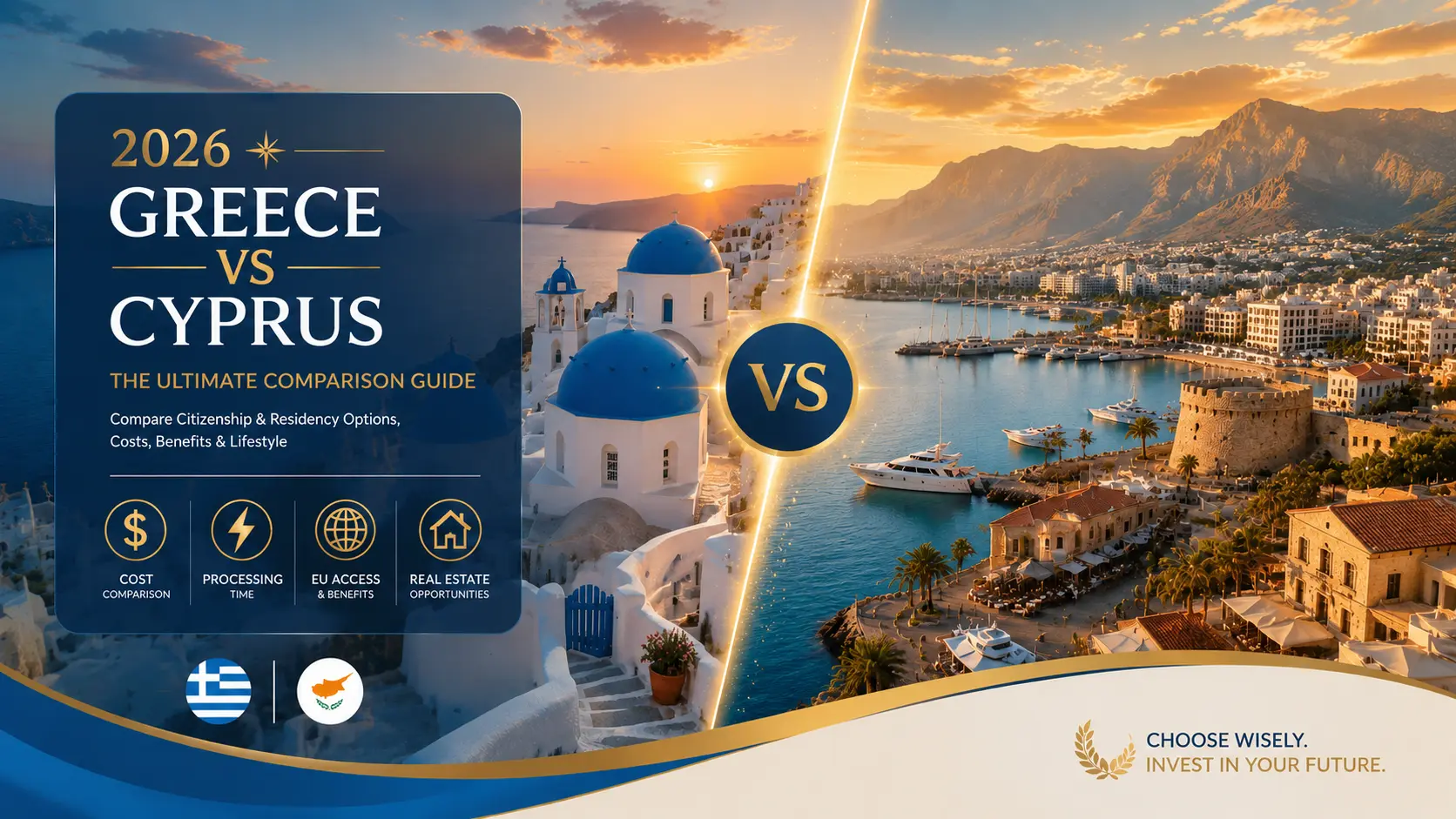
Cyprus vs Greece is the cleanest residency comparison in the EU. Greece is faster and cheaper at EUR 250,000 to 800,000 with three-month processing and citizenship after seven years. Cyprus needs EUR 300,000 with around six-month processing, but offers a stronger PR-to-citizenship path, lower corporate tax (12.5% vs 22%), and a 17-year non-dom regime that exempts dividends, interest, and rental income.
Cyprus vs Greece at a glance: the headline numbers
The two programmes solve different problems. Greece's Golden Visa is a tiered property route starting at EUR 250,000 for commercial-to-residential conversions and heritage-listed buildings, EUR 400,000 for standard residential outside the prime zones, and EUR 800,000 for properties in Athens centre, Mykonos, Santorini, and central Thessaloniki. Cyprus uses a flat EUR 300,000 minimum on new residential property under Category 6.2 fast-track.
| Feature | Cyprus PR (Cat 6.2) | Greece Golden Visa |
|---|---|---|
| Minimum investment | EUR 300,000 | EUR 250,000 - 800,000 (tiered) |
| Processing time | ~6 months | ~3 months |
| Citizenship eligibility | 8 years (5+1 continuous) | 7 years residency |
| Visa-free destinations | 174 | 185 |
| Corporate tax | 12.5% | 22% |
| Standard VAT | 19% | 24% |
| Property transfer tax | 3 - 8% tiered | ~3.09% |
| Annual property tax | Abolished 2017 | ENFIA (annual) |
| Tax incentive headline | 17-year non-dom (no tax on dividends, interest) | 7% flat tax on foreign retirement income (15 years) |
Read the table the right way and the answer falls out by buyer profile. A retiree drawing a pension from abroad and wanting EU access cheaply leans Greece. An entrepreneur, family office, or active investor who needs a long-term tax base inside the EU leans Cyprus.
Investment minimum: where Greece beats Cyprus, and where it does not
Greece looks cheaper on paper but the EUR 250,000 entry tier only applies to two narrow categories: commercial-to-residential conversions and heritage-listed buildings. Most buyers fall under the EUR 400,000 standard tier, and properties in Athens, Mykonos, Santorini, and central Thessaloniki demand EUR 800,000. Cyprus's flat EUR 300,000 sits between the two Greek tiers.
| Investment scenario | Greece cost | Cyprus cost |
|---|---|---|
| Cheapest legal entry | EUR 250,000 (heritage / conversion) | EUR 300,000 |
| Standard residential, secondary city | EUR 400,000 | EUR 300,000 |
| Prime central / island | EUR 800,000 | EUR 300,000 (no zoning premium) |
| Min. property size | 120 sqm (Tier 1-2) | No size minimum |
The detail that flips the comparison: Greece's Tier 1 and Tier 2 require a minimum property size of 120 square metres, which adds cost in higher-density urban product. Cyprus has no minimum size requirement, so a EUR 300,000 spend can be deployed across one larger unit or two smaller ones, both of which count toward the threshold. For investors who actually want to live in Athens, Greece is materially more expensive than the headline EUR 250,000 suggests.
Processing time and family inclusion
Greece processes Golden Visa applications in around three months end-to-end. Cyprus Category 6.2 fast-track runs around six months on the standard track, with some files clearing in two to three months on the fast-track stream. Both programmes include the spouse and dependent children, and neither requires the applicant to physically reside in the country to maintain status.
Greece's three-month timeline is the cleanest in the EU and a real advantage for clients who need an EU residence permit quickly, for example to relocate children to European universities or to establish proof of address for banking and visa purposes. Cyprus's six months is competitive globally but slower than Greece, Portugal (when active), and the UAE Golden Visa.
Family rules differ in detail. Greece includes the spouse, children under 21, and parents of both spouses with no upper age limit, which is unusually generous and a strong factor for multigenerational families. Cyprus includes the spouse and dependent children up to age 25 if financially dependent, but does not extend automatically to parents. For a family of four, the practical outcome is similar; for a three-generation household, Greece is more accommodating.
Citizenship path: the long-game advantage
Greece grants citizenship eligibility after seven years of residency, but the path requires actual physical residence and a Greek-language test. Cyprus requires eight years of legal residency (five cumulative years plus the final twelve months continuous before application), and the residency requirement is stricter on paper but more pragmatic in practice for non-residents who genuinely intend to settle.
The crucial nuance is that Greece's Golden Visa is a residence permit, not a residence in the legal sense for naturalisation. Applicants who use Greece purely as a property investment without spending real time in country struggle to satisfy the citizenship test. Cyprus's PR is similarly permit-based, but the route to citizenship is more clearly mapped, with the eight-year clock starting from PR grant and the residence test more transparent.
| Citizenship factor | Cyprus | Greece |
|---|---|---|
| Years to eligibility | 8 (5+1 continuous) | 7 |
| Language test | Greek (basic) | Greek |
| Physical residence required | Yes, last year continuous | Yes, throughout |
| Visa-free passport access | 174 destinations | 185 destinations |
| EU citizenship rights | Full | Full |
Greek passport access is broader on paper at 185 destinations versus 174 for Cyprus, but both deliver full EU rights, which is what most second-passport seekers actually want. The practical differentiator is intent: investors who genuinely plan to live in their chosen country and integrate locally will reach naturalisation in either system; passive investors who never spend time on the ground will struggle in both.
Tax regime: where Cyprus pulls clear
Cyprus's tax regime is the strongest single argument in this comparison. Corporate tax is 12.5%, one of the lowest in the EU. The non-domiciled regime exempts dividends, interest, and rental income from tax for 17 years. There is no inheritance tax, no wealth tax, and annual property tax was abolished in 2017. For active investors and business owners, the lifetime tax saving is material.
Greece's tax position is competitive but narrower. Corporate tax sits at 22%, which is around EU median. Greece offers two specialist regimes: a 7% flat tax on foreign-source retirement income for 15 years (subject to becoming Greek tax resident and not having a Greek pension), and a EUR 100,000 annual flat tax on global income for high-net-worth individuals (modelled on the Italian non-dom regime, which itself rose to EUR 300,000 per year for new entrants from 1 January 2026; family members EUR 50,000 each; pre-10 August 2024 entrants keep EUR 100,000; entrants between 10 August 2024 and 31 December 2025 keep EUR 200,000). Both are useful but apply to specific buyer profiles.
| Tax line | Cyprus | Greece |
|---|---|---|
| Corporate tax | 12.5% | 22% |
| Standard VAT | 19% | 24% |
| Dividend tax (non-dom) | 0% (17 years) | Standard rates |
| Inheritance tax | None | Up to 40% |
| Wealth tax | None | None |
| Foreign retiree special rate | Non-dom rules apply | 7% flat (15 years) |
| HNW flat tax option | Non-dom (passive income) | EUR 100,000 / year |
Run the maths on a concrete case. Take a digital entrepreneur drawing EUR 200,000 a year — say EUR 80,000 in salary from their own operating company, EUR 100,000 in dividends from that company, and EUR 20,000 in interest and rental income from passive holdings. In Cyprus, the operating company pays 12.5 percent corporate tax on profit, the EUR 80,000 salary attracts standard income tax bands (the first EUR 19,500 is tax-free, then progressive bands up to 35 percent above EUR 60,000), and under the non-dom regime the EUR 100,000 in dividends and the EUR 20,000 in interest and rental land at zero income tax and zero Special Defence Contribution for 17 years. The all-in effective tax burden lands in the high teens.
The same entrepreneur in Greece, becoming Greek tax resident outside the special regimes, pays 22 percent corporate tax on company profit, then progressive personal income tax up to 44 percent on the salary, then 5 percent withholding on dividends, then progressive rates on interest and rental. The all-in effective burden lands closer to 30 to 35 percent. The Greek HNW EUR 100,000 flat tax option closes most of the gap if the entrepreneur qualifies and elects in, but it costs EUR 100,000 per year regardless of income — Cyprus's non-dom is structurally free. For an active business owner with dividend-heavy compensation, Cyprus saves six figures of tax annually for 17 years. For a retiree on a EUR 60,000 foreign pension, Greece's 7 percent flat tax saves materially against any standard EU residency.
Lifestyle, climate, and expat infrastructure: where the day-to-day difference shows up
Climate is the headline similarity and the underrated differentiator. Both countries deliver a Mediterranean climate with 300-plus sunny days a year, mild wet winters, and hot dry summers. Cyprus is hotter and drier — Limassol summers regularly run above 35 degrees Celsius and rainfall is concentrated in a short December-to-February window. Mainland Greece and the islands are slightly cooler in summer with more weather variation, and Athens winters can run genuinely cold by Mediterranean standards. For families relocating from northern Europe or the Gulf, Cyprus delivers a more reliably warm climate; for buyers who want green seasonality and varied terrain, Greece offers more.
English-language access is where Cyprus pulls clearly ahead in everyday life. As a former British colony with a common-law legal system and English-medium business norms, Cyprus runs day-to-day administration, banking, healthcare, and legal work in English by default. Greece is more bureaucratic and more Greek-language dependent at the administrative layer — banking onboarding, tax filings, and dealings with public services typically require either a Greek-speaking advisor or working translation. For expats not planning to learn Greek to working level, this is a real friction tax.
Healthcare and schooling complete the picture. Cyprus introduced its General Healthcare System (GeSY) in 2019 and now offers universal cover at modest co-payment, alongside well-regarded private hospitals concentrated in Limassol and Nicosia. Greece has a deeper public health system on paper but a stronger private-clinic culture in practice; Athens delivers world-class private medicine, the islands less so. International schooling is denser in Cyprus per capita — Limassol, Nicosia, and Paphos each support multiple British and American curriculum schools — while Greece concentrates international options in Athens and Thessaloniki at fees of EUR 10,000 to 25,000 a year. The expat ecosystem in Cyprus is more concentrated, more anglophone, and easier to plug into; the expat ecosystem in Greece is larger in absolute terms but more dispersed and more Greek-integrated.
Property market: liquidity, growth, and entry quality
The Greek property market is larger, deeper, and more liquid than Cyprus, with more product across more price points. Athens has rebounded sharply since 2018 and now trades at EUR 3,500 to 6,500 per square metre in central districts. The islands are price-segmented: Mykonos and Santorini are EUR 8,000-plus per sqm, mainland coastal towns sit at EUR 1,500 to 3,000.
Cyprus is smaller and more concentrated. Limassol commands EUR 4,500 to 8,000 per sqm, Paphos EUR 2,500 to 4,500, Larnaca EUR 2,000 to 3,500, Nicosia EUR 1,800 to 3,200. The island has only four serious markets versus Greece's dozens, which simplifies analysis but limits diversification within a single national portfolio.
Liquidity matters at exit. Greek property sells faster on average because the buyer pool is larger and includes both EU and global capital. Cyprus property has a smaller resale market, but the post-2020 closure of the Cyprus Investment Programme has cooled the speculative top end, leaving the EUR 300,000 PR market populated by genuine end-users and developers focused on liveable family product. Both markets have grown steadily since 2018.
Lifestyle and EU benefits: the soft factors that decide it
Both passports and residency permits deliver Schengen mobility and full EU rights once citizenship is reached. The lifestyle differences are real. Greece is bigger, more diverse, and more chaotic, with stronger cultural depth, food, and Mediterranean island variety. Cyprus is smaller, more orderly, more anglophone, and more efficient for business, with a quieter rhythm and a tighter expat ecosystem.
For families, Cyprus offers stronger English-medium schooling and a denser expat community concentrated in Limassol and Paphos. Healthcare quality is high in both countries, with Cyprus generally rated higher on private-sector responsiveness and Greece offering broader public-system depth. Both are safe, both are warm, both have direct flight connectivity to most of Europe, the Middle East, and increasingly Asia.
The everyday business question favours Cyprus. English is the de facto working language across legal, banking, and corporate services. Company formation is fast and cheap, banking is functional for non-residents, and the legal system is common-law-derived (a colonial legacy that is genuinely useful for international clients). Greece is more bureaucratic, slower on banking, and a Greek-language layer sits between the foreign client and most administrative processes.
Cyprus or Greece? The right answer depends on your tax, family, and timeline.
Golden Keys Global runs side-by-side analysis on both programmes against your actual income mix and exit plan, then handles the entire application end to end.
Frequently asked questions
Is Cyprus or Greece better for residency by investment?
Greece is faster and cheaper at the entry tier. Cyprus offers stronger long-term tax treatment and a clearer citizenship path. The right answer depends on whether the investor is optimising for speed and price (Greece) or tax efficiency and permanence (Cyprus).
Which has a faster path to EU citizenship, Cyprus or Greece?
Greece on paper requires seven years of residency versus Cyprus's eight. In practice both require genuine physical residence and a basic Greek-language test, so the one-year difference is less significant than the residence pattern of the applicant.
Which country has lower taxes, Cyprus or Greece?
Cyprus has lower corporate tax at 12.5% versus 22%, and a 17-year non-dom regime that exempts dividends and interest. Greece offers a 7% flat tax on foreign retirement income for 15 years and an EUR 100,000 annual flat tax for HNW individuals. Cyprus is generally lower for entrepreneurs; Greece can be lower for retirees.
Can I get a homes for sale in Cyprus Greece comparison from one source?
Yes. Limassol new-build sits at EUR 4,500 to 8,000 per sqm, Athens centre at EUR 3,500 to 6,500, Mykonos at EUR 8,000-plus. Paphos at EUR 2,500 to 4,500 is broadly comparable to mainland coastal Greece. Cyprus has no annual property tax; Greece has ENFIA.
Does the Greece Golden Visa or Cyprus PR cover my family?
Both programmes cover spouse and dependent children. Greece extends to parents of both spouses with no upper age limit, which is more generous for multigenerational families. Cyprus covers dependent children up to age 25 if financially dependent.
Can I apply to both Cyprus and Greece simultaneously?
Yes, the two programmes are not mutually exclusive and many investors hold residency in both. The practical question is tax residency, which can only be claimed in one country at a time and is determined by physical presence and centre-of-life tests.
Last updated: March 2026. This article compares two active EU residency programmes for informational purposes only. Programme rules, processing times, and tax regulations change. Always consult a qualified Cypriot or Greek lawyer and tax advisor before applying. Golden Keys Global provides advisory and facilitation services in both jurisdictions.