
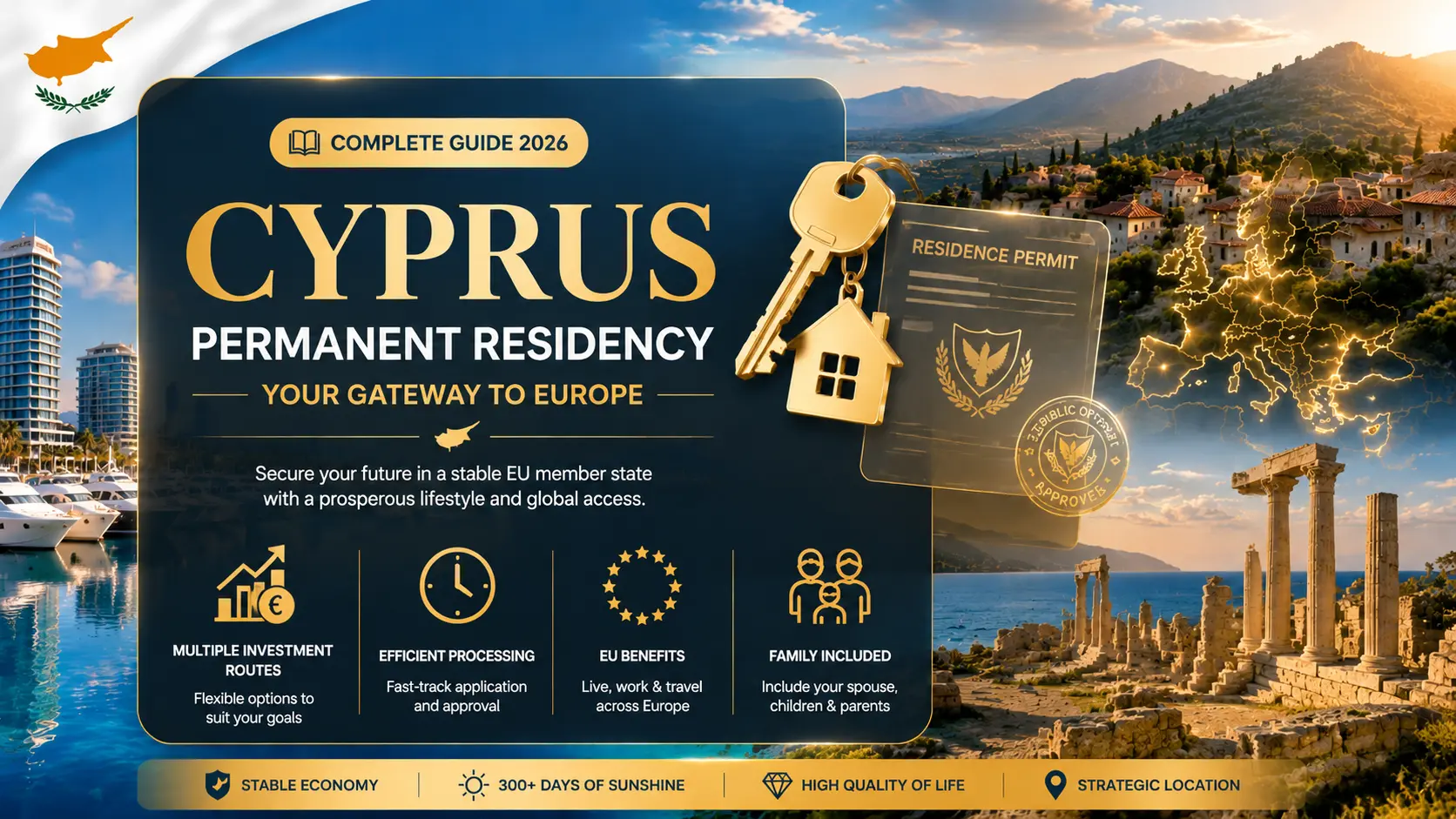
The Cyprus permanent residency programme grants lifetime EU residency through a EUR 300,000 property purchase, EUR 30,000 frozen bank deposit, and EUR 50,000 annual income proof from foreign sources. Category 6.2 fast-track approvals close in 2 to 3 months and cover the entire family. After 8 years of legal residency, holders qualify to apply for Cyprus citizenship through standard naturalisation.
What the Cyprus permanent residency programme actually offers
The Cyprus permanent residency programme (Category 6.2 fast-track) gives non-EU nationals a permanent right to live in Cyprus through real estate investment. Unlike temporary residence permits, the PR card never expires and does not require annual renewals. It covers the main applicant, spouse, and dependent children, and parents can be added under specific conditions.
Cyprus is a full EU member state with English as a working language for legal, banking, and government affairs. Although Cyprus is not yet part of the Schengen Area, the country is on track for Schengen accession in 2026. Once integrated, PR holders will benefit from visa-free Schengen circulation, in addition to the visa-free travel they already enjoy to 174 destinations on a Cypriot passport after naturalisation.
The programme is a residency-by-investment route, not a citizenship-by-investment route. The Cyprus Investment Programme (CIP) that previously offered direct citizenship was closed in October 2020. PR plus 8 years of legal residency is now the active route to a Cyprus passport.
Cyprus permanent residency requirements at a glance
To qualify for Category 6.2 fast-track Cyprus PR, you need a EUR 300,000 minimum residential property purchase, a EUR 30,000 fixed bank deposit locked for 3 years, and EUR 50,000 in proven annual income that must originate from outside Cyprus. Each dependent adds to the income requirement: EUR 15,000 for a spouse and EUR 10,000 per child.
| Requirement | Detail |
|---|---|
| Property investment | EUR 300,000 minimum (excluding VAT) on new residential property |
| Bank deposit | EUR 30,000 fixed for 3 years in a Cyprus bank |
| Annual income | EUR 50,000 from foreign sources for main applicant |
| Income for spouse | EUR 15,000 additional |
| Income per dependent | EUR 10,000 additional per child |
| Clean criminal record | Required from country of origin and any country of prior residence |
| Health insurance | Private cover for the applicant and family |
| Source of funds | Documentary evidence required for the entire investment |
The property must be brand new and purchased directly from a developer. Resale property is not eligible under the fast-track Category 6.2. Source-of-funds documentation has tightened across all EU programmes, so expect bank statements, tax returns, and explanation memos for any large transfers.
Cyprus permanent residency benefits beyond the PR card
The programme delivers tangible lifestyle, tax, and mobility advantages. The PR card is permanent (no renewal cycle), covers the whole family on a single application, and acts as the foundation for an EU passport after 8 years.
Tax is the underrated piece. The Cyprus non-domiciled status exempts qualifying residents from tax on worldwide dividends, interest, and rental income for 17 years. Corporate tax is fixed at 12.5%, one of the lowest in the EU. There is no inheritance tax, no wealth tax, and no immovable property tax. For high-net-worth families relocating from high-tax jurisdictions, the savings can outweigh the entire investment within a single decade.
| Benefit | Detail |
|---|---|
| PR card validity | Permanent (no renewal) |
| Family inclusion | Spouse and dependent children |
| Citizenship pathway | Apply after 8 years of legal residency |
| Visa-free travel (post-citizenship) | 174 destinations |
| Non-dom tax status | Tax-free dividends, interest, rental income (17 years) |
| Corporate tax | 12.5% |
| Inheritance tax | None |
| VAT | 19% standard |
Living costs in Cyprus also undercut most of Western Europe, while the climate (over 320 days of sunshine), English-language schools, and modern healthcare make it one of the easier EU relocations for families.
How to get permanent residency in Cyprus: step-by-step
From property selection to PR card delivery, expect a 4 to 6 month total timeline if you move efficiently. The Cyprus Civil Registry and Migration Department targets 2 to 3 months for the actual fast-track application review, with property due diligence and document gathering taking the remaining time.
- Property selection (2 to 6 weeks). Identify a new-build residential property at or above EUR 300,000. Verify the developer's title situation and VAT treatment.
- Reservation and contracts (1 to 2 weeks). Pay the reservation deposit, sign sale agreement, lodge it with the Land Registry.
- Bank account opening (2 to 4 weeks). Open a Cyprus bank account, transfer the EUR 30,000 fixed deposit and the property funds. Banks require full KYC.
- Document apostille and translation (3 to 6 weeks). Apostille birth, marriage, criminal records and translate into Greek where required.
- PR application submission. File Form M.67 with the Civil Registry and Migration Department along with property contract, deposit confirmation, income proof, insurance, and family documents.
- Approval and biometrics (2 to 3 months). On approval, the family travels to Cyprus within 12 months for biometric capture and PR card issuance.
Category 6.2 fast-track vs Category F standard PR
Cyprus has historically offered two PR routes. Category 6.2 is the fast-track investment route described in this guide. Category F is the older general permanent residence route based on stable, sufficient income from abroad without an investment trigger. Category F has lower cash thresholds but materially slower processing, more discretion in the decision, and typically requires applicants to be retirees or financially independent.
| Feature | Category 6.2 fast-track | Category F standard |
|---|---|---|
| Property investment | EUR 300,000 minimum (new) | Not required |
| Income proof | EUR 50,000+ foreign source | Lower threshold, stable income |
| Bank deposit | EUR 30,000 (3-year hold) | Not required |
| Processing time | 2 to 3 months | 6 to 12 months typical |
| Discretion | Limited (rules-based) | High (case-by-case) |
| Best for | HNW families relocating now | Retirees with stable pension |
For most active investors and entrepreneurs moving from the US, UK, Middle East, or Africa, Category 6.2 is the more predictable route. Approval is largely a function of meeting the financial thresholds and passing the clean record check, rather than convincing an officer your situation merits residence.
Cyprus permanent residency card: rules, renewals, obligations
The Cyprus permanent residency card itself does not expire. However, holders must visit Cyprus at least once every 2 years to maintain their status. There is no minimum stay obligation. You do not need to physically live in Cyprus to keep the card, which makes the programme attractive to internationally mobile families who want optionality without uprooting their entire life.
If you actually want to count the years toward citizenship, that is when residency rules kick in. Cyprus naturalisation requires 8 years of legal residency in total, with at least 7 of the 12 years preceding the application spent in Cyprus, and the entire 12 months immediately preceding the application spent in the country. Greek language proficiency at B1 level is also required for naturalisation.
The PR card must be presented at the airport on entry alongside your passport. Lost or stolen cards are reissued through the Civil Registry and Migration Department for a small fee. Any change of property, employment status, or family composition should be reported to keep your file current.
Cyprus PR vs Greece, Malta, and Portugal Golden Visas
Cyprus is one of several EU residency-by-investment routes. The differences come down to investment level, processing speed, lifestyle fit, and citizenship horizon. Cyprus often wins on price-per-benefit when you factor in the non-dom tax regime.
| Programme | Min investment | Processing | Citizenship |
|---|---|---|---|
| Cyprus PR (Cat 6.2) | EUR 300,000 property | 2 to 3 months | 8 years |
| Greece Golden Visa | EUR 250,000 to 800,000 | ~3 months | 7 years |
| Malta PR | EUR 300,000+ (property + contribution) | 4 to 6 months | Separate process |
| Portugal Golden Visa | EUR 500,000 (funds) | 12 to 24 months | 5 years |
Cyprus and Greece are direct comparators at the EUR 250 to 400K range. Cyprus wins on tax (non-dom regime) and approval speed. Greece wins on Schengen access today and a slightly shorter naturalisation timeline. Portugal wins on shortest citizenship horizon (5 years) but lost the residential property route and now has 1 to 2 year processing backlogs.
Ready to assess Cyprus PR for your family?
Our team handles property selection, banking, and the Category 6.2 application end to end.
Tax planning for Cyprus PR holders
Becoming a Cyprus permanent resident does not automatically make you a Cyprus tax resident. Two separate triggers apply. The classic 183-day rule still holds, but Cyprus also offers an unusually flexible 60-day rule. Spend 60 or more days in Cyprus, do not spend 183 days in any other country, do not be tax resident anywhere else, and maintain economic ties (a Cyprus business, employment, or directorship) — and you qualify as a Cyprus tax resident.
Once tax resident, the non-domiciled regime kicks in for 17 years, exempting you from tax on dividends, interest, and rental income worldwide. Personal income tax bands run 0 to 35% with the first EUR 19,500 tax free. Corporate tax is 12.5%. There is no inheritance tax, no wealth tax, and no annual property tax. CFC (controlled foreign company) rules do apply, so structuring of holding companies should be reviewed by a Cyprus tax advisor.
For US citizens, none of this overrides US worldwide income reporting. You will continue filing Form 1040 every year. The US-Cyprus tax treaty plus Foreign Tax Credit usually mitigates double taxation, but FATCA and FBAR filings on your Cyprus accounts are mandatory.
Common mistakes that delay or kill the application
Most rejections or delays are avoidable. The Cyprus migration department has tightened source-of-funds review since 2023, and applications that look thin on documentation get pushed to the back of the queue. The most common issues we see:
- Buying resale property. Category 6.2 fast-track requires NEW residential property purchased directly from the developer. Resale property pushes you into the slower Category F route.
- Income from Cyprus sources. The EUR 50,000 income must originate outside Cyprus. Salary from a Cyprus employer or rental income from your Cyprus property does not count toward this threshold.
- Single-source bank statements. Source of funds requires a documented trail. Lump-sum transfers without bank statements showing accumulation will trigger requests for further evidence.
- Missing apostilles. Birth certificates, marriage certificates, and police clearance certificates from non-EU countries need apostille and certified Greek translation.
- Stale criminal record certificates. Police clearances older than 3 months at submission are rejected.
The fix is process discipline. Order police clearances last (after all other documents are ready), keep parallel copies of bank statements going back 12 months, and do not wire investment funds through unrelated third-party accounts.
Frequently asked questions
Last updated: March 2026. The information in this article is for general guidance only and does not constitute legal, tax, or migration advice. Cyprus immigration regulations and tax legislation change frequently. Always consult a licensed advisor before committing capital to any residency programme. Golden Keys Global is an independent advisory firm and is not affiliated with any government agency.