
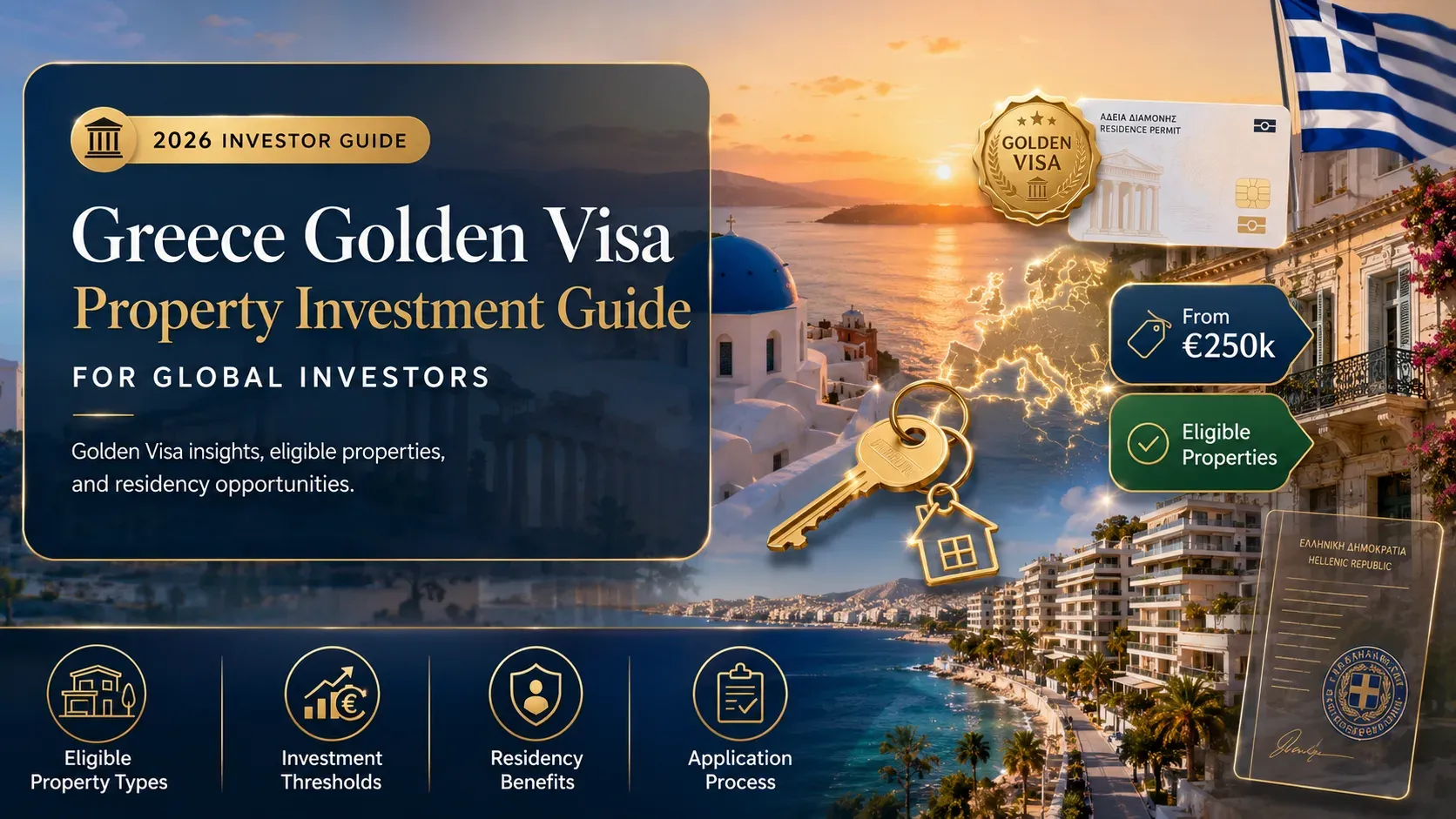
Yes, foreigners can buy property in Greece, and doing so can qualify you for the Greek Golden Visa, one of Europe's most established residency-by-investment programmes. Greece uses a tiered pricing system: properties in Athens centre, Mykonos, and Santorini require a minimum investment of EUR 800,000, while emerging areas start from EUR 400,000 and commercial-to-residential conversions qualify from EUR 250,000. Transfer tax is approximately 3.09%. The Golden Visa grants residency in roughly three months, and Greek citizenship becomes available after seven years of legal residence, delivering a passport with visa-free access to 185 countries. This guide covers how to buy property in Greece as a foreigner, the full cost breakdown, the Golden Visa connection, and what Americans and other non-EU buyers need to know.
Can foreigners buy property in Greece?
Yes. Greece places virtually no restrictions on foreign property ownership. Citizens of any country, including Americans, Canadians, Australians, and non-EU nationals, can purchase residential and commercial real estate in Greece under the same terms as Greek citizens.
The one exception involves border regions and certain islands near Turkey, where non-EU nationals may need approval from the Ministry of Defence. This applies to a limited number of areas and does not affect the vast majority of property purchases in Athens, Thessaloniki, the Cyclades, the Peloponnese, or Crete. Your legal counsel will confirm whether a specific property falls within a restricted zone during the due diligence phase.
Foreign buyers must obtain a Greek tax number (AFM) before completing any property transaction. This is a straightforward process handled through the local tax office or by a legal representative with power of attorney. You do not need to be physically present in Greece to obtain an AFM, and the process typically takes a few days. A Greek bank account is also recommended for managing property-related payments, though not always strictly required for the purchase itself.
Greece Golden Visa investment tiers explained
The Greek Golden Visa operates on a tiered investment structure based on property location and type. The tiers were restructured in 2024, replacing the previous flat EUR 250,000 threshold for most areas with a location-based system.
| Tier | Location / Property Type | Minimum Investment | Min Size |
|---|---|---|---|
| Tier 1 | Athens centre, Mykonos, Santorini | EUR 800,000 | 120 sqm |
| Tier 2 | Emerging areas (outside Tier 1 zones) | EUR 400,000 | 120 sqm |
| Tier 3 | Commercial-to-residential conversions | EUR 250,000 | No minimum |
| Tier 4 | Heritage building restorations | EUR 250,000 | No minimum |
Tier 1 covers the highest-demand areas: central Athens (within the municipality boundaries), Mykonos, and Santorini. These are the most competitive property markets in Greece, with strong rental yields driven by tourism and international demand. The EUR 800,000 threshold reflects both market reality and the government's intent to attract substantial investment into these premium zones.
Tier 2 encompasses most of the rest of Greece, including popular destinations like Thessaloniki, Crete, Rhodes, Corfu, the Peloponnese, and Athens suburbs outside the central municipality. At EUR 400,000, this tier remains competitive with other European Golden Visa programmes while opening access to areas with significant growth potential and lower entry costs per square metre.
Tiers 3 and 4, at EUR 250,000, are the most affordable entry points. Commercial-to-residential conversions involve purchasing a commercial property (such as an office or warehouse) and converting it to residential use. Heritage restorations involve listed or historically significant buildings. Both routes require renovation and conversion work, which adds cost and complexity beyond the purchase price, but they offer the lowest qualifying threshold for the Golden Visa.
How to buy property in Greece: step-by-step process
The Greek property purchase process is well-established and follows a clear legal framework. From initial search to title deed registration, the process typically takes two to four months, though Golden Visa processing adds approximately three months after the property transaction is completed.
- Obtain a Greek tax number (AFM). Required before any property transaction. Your lawyer can obtain this on your behalf with power of attorney.
- Engage a lawyer. Greek law does not require a lawyer for property purchases, but it is strongly advised for foreign buyers. Your lawyer conducts title searches, verifies building permits, checks for encumbrances, and ensures the property qualifies for Golden Visa purposes if applicable.
- Property search and due diligence. Identify properties that meet your investment and lifestyle criteria. For Golden Visa applicants, confirm the property meets the minimum investment and size requirements for its tier.
- Preliminary agreement and deposit. Once you select a property, a preliminary agreement is signed and a deposit (typically 10%) is paid. This agreement is legally binding.
- Title search and legal checks. Your lawyer verifies clean title, confirms no outstanding debts or liens, checks planning permissions, and reviews the property's legal status at the Land Registry or Cadastre.
- Final contract at the notary. The sale is completed before a Greek notary. Both parties (or their legal representatives) sign the final deed. The purchase price is paid, and the transfer tax of approximately 3.09% is settled.
- Registration at the Land Registry. The notarial deed is registered, completing the transfer of ownership. You are now the legal owner.
- Golden Visa application (if applicable). With the registered deed and proof of investment, your lawyer submits the Golden Visa application to the Greek immigration authority. Processing takes approximately three months.
The entire process from property identification to Golden Visa approval typically takes five to seven months. Buyers who have their AFM, bank account, and legal team in place before arriving in Greece can complete the property transaction within a few weeks of selecting a property.
Full cost breakdown for buying property in Greece
The purchase price is the largest cost, but several additional expenses apply. Understanding the full cost structure prevents surprises and ensures your total investment meets Golden Visa thresholds where applicable.
| Cost Component | Amount | Notes |
|---|---|---|
| Property price | EUR 250,000 - 800,000+ | Depends on tier and location |
| Transfer tax | ~3.09% of declared value | Paid at time of purchase |
| Notary fees | ~1.0-1.5% | Based on property value |
| Legal fees | ~1.0-1.5% | Lawyer fees for due diligence |
| Land Registry fees | ~0.5-0.7% | Registration of the deed |
| Agent commission | ~2% | Typically paid by seller, but varies |
| Golden Visa application | EUR 2,000 | Per main applicant |
For a EUR 400,000 property in a Tier 2 location, total acquisition costs including tax, notary, legal, and registration fees will be approximately EUR 425,000 to EUR 435,000. The Golden Visa application fee is separate and applies per applicant. Dependants (spouse, children under 21, parents) can be included on the same Golden Visa application with additional fees per person.
Buying property in Greece as an American
Americans face no additional restrictions when purchasing property in Greece. The process is identical to that for EU nationals, with the same tax rates, legal requirements, and Golden Visa eligibility. Greece does not discriminate by nationality for property ownership outside the limited border-zone restrictions.
American buyers should be aware of US tax obligations. The United States taxes its citizens on worldwide income regardless of residence. Rental income from Greek property must be reported on your US tax return. Capital gains on property sale are also reportable. The US-Greece tax treaty provides mechanisms to avoid double taxation, but professional tax advice from an adviser familiar with both jurisdictions is essential.
FBAR (Foreign Bank Account Report) and FATCA obligations apply if you open a Greek bank account with balances exceeding the reporting thresholds. These are disclosure requirements, not additional taxes, but non-compliance carries significant penalties. Your US tax adviser should be informed about any Greek accounts from the outset.
For Americans considering the Golden Visa as a path to Greek citizenship, the seven-year residency period runs from the date the Golden Visa is issued. Greek citizenship requires passing a language and civics exam. Greece permits dual citizenship, so Americans can hold both a US and Greek passport simultaneously. The Greek passport provides visa-free access to 185 countries, complementing the US passport's already strong mobility profile.
Buy property in Athens: market overview
Athens is Greece's largest property market and the focal point for international investment. Central Athens falls under Tier 1 with an EUR 800,000 minimum for Golden Visa qualification, while Athens suburbs and the wider Attica region fall under Tier 2 at EUR 400,000.
The distinction between central Athens and greater Athens matters significantly for Golden Visa planning. Central Athens (the Municipality of Athens) includes neighbourhoods like Kolonaki, Plaka, Exarchia, Pangrati, Koukaki, and the city centre. Properties here command premium prices per square metre but benefit from the strongest rental demand, driven by both long-term tenants and short-term tourism.
The southern suburbs (Glyfada, Voula, Vouliagmeni) and northern suburbs (Kifisia, Marousi, Psychiko) are outside the central municipality and qualify under Tier 2 at EUR 400,000. These areas offer larger properties, family-friendly environments, and proximity to beaches or green spaces. For buyers who want to live in Athens rather than invest purely for rental yield, the suburbs often provide better value in terms of space and lifestyle.
Piraeus, the port city adjacent to Athens, is classified separately and represents one of the more affordable areas within the greater Athens metropolitan zone. Piraeus properties with sea views and proximity to the marina district have seen steady appreciation, and the area qualifies under Tier 2 pricing for Golden Visa purposes.
Cheap property in Greece: where to look
Greece offers some of the most affordable property in the European Union, particularly outside the major tourist islands and central Athens. For buyers whose primary goal is value rather than Golden Visa qualification, several regions provide entry points well below the Golden Visa minimums.
The Peloponnese remains one of the most undervalued regions. Coastal towns like Nafplio, Kalamata, and Pylos offer sea-view properties at a fraction of island prices. Mainland Greece, including areas around Thessaly, Epirus, and Western Macedonia, provides even lower entry points. These areas are popular with retirees and remote workers seeking affordable Mediterranean living.
For Golden Visa applicants seeking the lowest qualifying threshold, the commercial conversion route at EUR 250,000 is the entry point. This requires purchasing a commercial property and converting it to residential use, which involves renovation costs on top of the purchase price. Heritage building restorations also qualify at EUR 250,000 but require working with listed structures and navigating heritage preservation regulations.
Crete, Greece's largest island, spans a wide price range. The north coast (Chania, Rethymno, Heraklion) commands tourist-area premiums, while the south coast and interior villages remain significantly more affordable. Crete falls under Tier 2 for Golden Visa purposes at EUR 400,000, making it accessible for investment buyers who want island lifestyle without Mykonos or Santorini pricing.
Can I buy property in Greece to get residency?
Yes. The Greek Golden Visa is explicitly designed to grant residency to foreign property investors. Purchasing qualifying real estate at or above the applicable tier threshold entitles you to a five-year renewable residency permit, processed in approximately three months.
The Golden Visa residency permit grants the right to live in Greece and travel freely within the Schengen Area (29 countries) for up to 90 days in any 180-day period. There is no minimum stay requirement in Greece to maintain the permit. You can renew it every five years as long as you retain ownership of the qualifying property.
The residency-to-citizenship pathway requires seven years of legal residence. Unlike the residency permit itself, citizenship requires demonstrating genuine ties to Greece, including physical presence, language proficiency (Greek language exam), and knowledge of Greek history and culture (civics exam). Not all Golden Visa holders will want or qualify for citizenship, but those who do gain a passport with access to 185 visa-free countries and full EU citizen rights including the right to live and work anywhere in the European Union.
Family members can be included on the same Golden Visa application. Eligible dependants include your spouse, children under 21, and parents of both the main applicant and the spouse. Each dependant pays an additional application fee but does not need to make a separate property investment. The family residency permits are tied to the main applicant's property ownership.
Greece Golden Visa vs other European programmes
With Spain's Golden Visa ending in April 2025 and Portugal removing real estate from its programme in October 2023, Greece is now the premier European property-based residency programme. The table below compares Greece with remaining alternatives.
| Country | Property Route | Min Investment | Processing | Citizenship Timeline |
|---|---|---|---|---|
| Greece | Active | EUR 250,000-800,000 | ~3 months | 7 years |
| Portugal | Removed (Oct 2023) | EUR 500,000 (funds only) | 6-24 months (by vintage) | 10 years (7 for EU/CPLP) |
| Spain | Ended (Apr 2025) | N/A | N/A | N/A |
| Malta (MPRP) | Active (residency only) | EUR 300,000-350,000 + fees | 4-6 months | Discretionary |
| Cyprus | Active | EUR 300,000 | ~6 months | 8 years |
| Italy | Investor visa | EUR 250,000 (startup) | 3-4 months | 10 years |
Greece's advantages are clear: the fastest processing time, the widest range of qualifying property types, and a seven-year citizenship pathway that is shorter than Cyprus (eight years), Italy (ten years), and Portugal (now 10 years for most applicants, 7 years for EU and CPLP nationals, under Lei Orgânica n.º 1/2026 (Diário da República n.º 95/2026, published 18 May 2026), in force since 19 May 2026 — applications submitted before 19 May 2026 retain the prior 5-year rule under transitional provisions). Portugal also no longer accepts real estate investment and processing runs 6-24 months depending on application vintage.
For investors who want to buy physical property in Europe and obtain residency with a clear path to citizenship, Greece is the standout choice in 2026. The tiered pricing system means there is an entry point for various budgets, from EUR 250,000 commercial conversions to EUR 800,000 premium Athens apartments.
Buy property in Greece with expert guidance
From property selection and legal due diligence to Golden Visa application and family inclusion, the process requires coordinating multiple professionals across jurisdictions.
Frequently asked questions
How much does it cost to buy property in Greece for a Golden Visa?
It depends on location. Athens centre, Mykonos, and Santorini require EUR 800,000. Emerging areas require EUR 400,000. Commercial conversions and heritage restorations qualify from EUR 250,000. All Tier 1 and Tier 2 properties must be at least 120 square metres.
Can Americans buy property in Greece?
Yes. Americans face no additional restrictions compared to EU nationals. The process, tax rates, and Golden Visa eligibility are identical. Americans should be aware of US worldwide income reporting obligations on rental income and FBAR requirements for Greek bank accounts.
What is the transfer tax on Greek property?
Transfer tax is approximately 3.09% of the declared property value, paid at the time of purchase. Additional costs include notary fees (1-1.5%), legal fees (1-1.5%), and Land Registry fees (0.5-0.7%).
Do I need to live in Greece to keep the Golden Visa?
No. The Greek Golden Visa has no minimum stay requirement. You maintain residency by retaining ownership of the qualifying property and renewing the permit every five years.
How long does it take to get Greek citizenship through property investment?
Seven years from the date your Golden Visa residency permit is issued. Citizenship requires passing Greek language and civics exams and demonstrating genuine ties to Greece. Greece permits dual citizenship.
Can I rent out my Golden Visa property?
Yes. There are no restrictions on renting your property, whether long-term or short-term (such as Airbnb). Rental income is subject to Greek income tax. Many Golden Visa investors generate rental yield to offset holding costs, particularly in high-demand tourist areas.
This article is for informational purposes only and does not constitute legal, tax, or immigration advice. Property prices, Golden Visa thresholds, and tax rates are subject to change. Always consult a qualified lawyer and tax adviser before purchasing property in Greece. Information verified as of March 2026.