
Visa requirements for Europe for US citizens: Essential guide (2026)
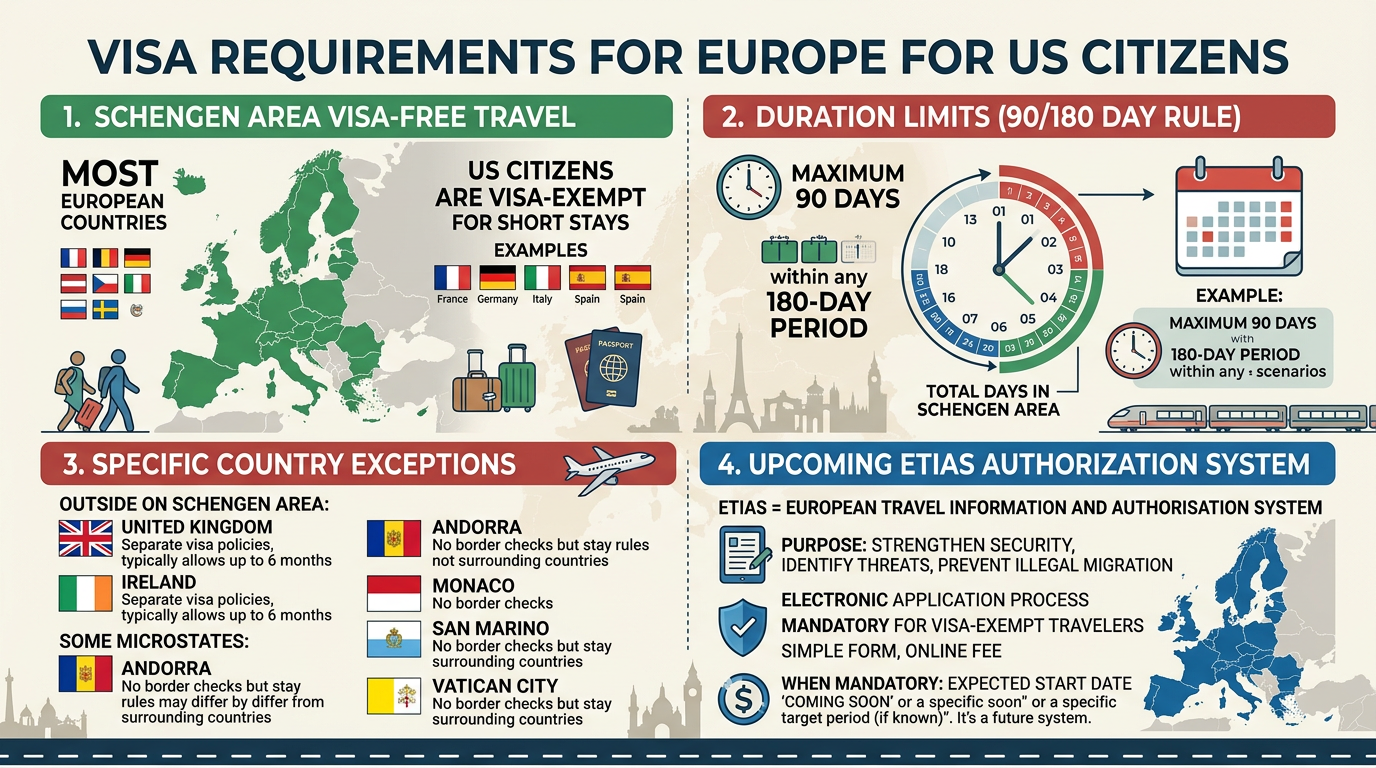
US citizens can visit most European countries for up to 90 days within any 180-day period without a visa under the Schengen Agreement. However, the rules change dramatically if you want to stay longer, work, retire, or invest. This guide covers everything from short-term Schengen travel to long-stay D visas, Golden Visa residency routes, and the upcoming ETIAS system, whose Q4 2026 launch target the European Commission removed in mid-July 2026 (a 2027 launch is now most likely, followed by a six-month transitional grace period before authorisation becomes mandatory).
The critical distinction most Americans miss: visa-free travel is for tourism only. The moment you want to work, start a business, buy property to live in, or stay beyond 90 days, you need a specific visa or residence permit. Getting this wrong can result in overstay penalties, deportation, and bans on future entry.
The Schengen Area: What US citizens need to know
The Schengen Area is a zone of 29 European countries that have abolished internal border controls. US passport holders can enter any Schengen country and travel freely within the zone for up to 90 days within any rolling 180-day period. No visa is required for this short-stay travel. (Bulgaria and Romania completed full Schengen membership on 1 January 2025; air and sea borders opened 31 March 2024.)
The 90/180 rule is strict and cumulative. Every day you spend in any Schengen country counts toward your 90-day allowance. If you spend 30 days in France and 30 days in Italy, you have 30 days remaining before you must leave the entire Schengen zone for at least 90 days to reset the clock.
Countries in the Schengen Area include France, Germany, Italy, Spain, Portugal, Greece, the Netherlands, Austria, Belgium, and 18 others. Notable European countries outside Schengen include the UK, Ireland, Cyprus, and several Balkan nations, each with their own visa rules.
During your 90-day visa-free stay, you may engage in tourism, business meetings, and cultural activities. You may not work for a European employer, enrol in long-term education, or establish tax residency. Violating these conditions risks serious immigration consequences.
What is the Schengen visa and when do US citizens need one?
A Schengen visa (Type C) is a short-stay visa for nationals who are not visa-exempt. US citizens do not need a Schengen visa for stays up to 90 days -- the US passport provides visa-free entry. However, understanding the system matters because ETIAS will add a new layer of pre-travel authorisation.
If you need to stay in the Schengen Area beyond 90 days, a Type C visa will not help. You need a national long-stay visa (Type D), which is issued by the specific country where you plan to reside. Each country sets its own rules for Type D visas, and they are not interchangeable.
Common scenarios where US citizens need a Type D visa include retirement, employment, study, family reunification, and investment-based residency. The Type D visa is your entry document; once in-country, you convert it to a residence permit that allows you to stay long-term.
The key takeaway: short visits are simple, but anything beyond tourism requires country-specific planning and applications submitted before you travel. You cannot enter on your 90-day allowance and then "switch" to a long-stay permit from inside the country in most cases.
ETIAS: The new pre-travel requirement for Europe
The European Travel Information and Authorisation System (ETIAS) is not yet operational. The European Commission removed its Q4 2026 launch target in mid-July 2026 after eu-LISA concluded a 2026 launch was no longer feasible. A revised timeline is expected after eu-LISA's September 2026 board meeting; a 2027 launch is now most likely. A six-month transitional grace period will follow whenever ETIAS goes live before authorisation becomes mandatory. Once active, US citizens will need to obtain ETIAS authorisation before travelling to the Schengen Area, even for short visits that are currently visa-free. The fee is EUR 20 (raised from EUR 7 by the European Commission on 17 July 2025; takes effect when ETIAS becomes operational).
ETIAS is not a visa. It is an electronic travel authorisation similar to the US ESTA system for travellers visiting America under the Visa Waiver Program. You apply online, provide basic personal information, and receive authorisation linked to your passport. The process is expected to be straightforward, with most approvals issued quickly.
ETIAS does not change the 90/180-day rule. US citizens will still be permitted to stay for up to 90 days within any 180-day period without a visa. The difference is that you must have approved ETIAS authorisation before boarding your flight or arriving at a Schengen border.
Travellers should monitor the official ETIAS website for confirmed launch dates and application procedures. The system has been delayed multiple times; the European Commission removed its Q4 2026 launch target in mid-July 2026 after eu-LISA concluded a 2026 launch was no longer feasible, and a 2027 launch is now most likely, followed by a six-month transitional grace period before authorisation becomes mandatory. Planning trips to Europe in late 2026 and 2027 should factor in the possibility that ETIAS may be required by the time you travel.
How to get a visa to stay in Europe long-term
US citizens who want to live in Europe beyond 90 days need a national long-stay visa (Type D) from the specific country where they plan to reside. The application process, requirements, and processing times vary by country and visa category. Here are the most common routes.
Golden Visa / residency by investment
Several European countries offer residence permits in exchange for qualifying investments. These are the most accessible routes for US citizens with capital, as they do not require employment or family ties. Active programmes include Greece, Portugal, Cyprus, Italy, and Malta.
D7 / passive income visa
Portugal's D7 visa allows non-EU nationals with stable passive income (pensions, investments, rental income) to obtain residency. This is popular with American retirees who have sufficient income but do not want to make the EUR 500,000 Golden Visa investment.
Digital Nomad visas
Several European countries now offer visas for remote workers employed by non-European companies. Spain, Portugal, Greece, and others have introduced digital nomad visa categories since 2022. These typically require proof of remote employment and minimum income thresholds.
Non-Lucrative / retirement visas
Spain and Italy both offer non-lucrative visas for individuals who can demonstrate sufficient financial means to live without working. These are ideal for retirees and financially independent individuals.
Greece visa requirements for US citizens
US citizens can visit Greece visa-free for up to 90 days under the Schengen Agreement. For longer stays, Greece offers several pathways, with the Golden Visa being the most popular for investors.
The Greece Golden Visa requires real estate investment with tiered minimums: EUR 800,000 in premium zones, EUR 400,000 in secondary zones, and EUR 250,000 in designated areas. Processing takes approximately three months, making it the fastest European Golden Visa programme.
Greek residency provides Schengen Area travel rights, meaning you can move freely across 29 European countries. Citizenship is available after seven years of residency, culminating in a passport with visa-free access to 185 countries.
For US citizens specifically, Greece is attractive because the real estate investment provides both a residence permit and a tangible asset in Europe. The three-month processing time is significantly faster than Portugal's 12-18 months, making Greece the preferred choice for Americans who want to establish European residency quickly.
Greece does not currently have a digital nomad visa programme comparable to Spain or Portugal, so the Golden Visa or standard employment visa remain the primary long-stay options for US nationals.
| Stay type | Visa needed? | Max duration | Key requirement |
|---|---|---|---|
| Tourism | No (visa-free) | 90 days / 180-day period | Valid US passport |
| Golden Visa | Type D then permit | 5 years (renewable) | EUR 250K-800K real estate |
| Employment | Type D work visa | 1-2 years (renewable) | Job offer from Greek employer |
| Citizenship | Via naturalisation | Permanent | 7 years residency |
Golden Visa routes: The investment path to European residency
For US citizens with capital to invest, Golden Visa programmes offer the most direct path to European residency without needing employment, family ties, or ancestry claims. Here is a comparison of every active European Golden Visa programme available to Americans in 2026.
| Country | Min. investment | Processing | Citizenship path |
|---|---|---|---|
| Greece | EUR 250K-800K (real estate) | ~3 months | 7 years |
| Portugal | EUR 500K (funds) | 12-18 months | 10 years (7 for EU/CPLP nationals; per Lei Orgânica n.º 1/2026, Diário da República n.º 95/2026 published 18 May 2026, in force 19 May 2026; applications submitted before 19 May 2026 retain the prior 5-year rule under transitional provisions) |
| Cyprus | EUR 300K (real estate) | ~6 months | 8 years |
| Italy | EUR 250K-2M | 3-4 months | 10 years |
| Malta (MPRP) | EUR 28K-58K + property | 4-6 months | Active (residency only). Malta's MEIN citizenship-by-investment ENDED — permanently ended by Act XXI of 2025 following the ECJ ruling of 29 April 2025 (Case C-181/23). MPRP residency programme remains active. |
Spain's Golden Visa ended in April 2025. This is particularly relevant for US citizens, as Spain was previously one of the most popular European destinations for American investors and retirees. If Spain was your target, Greece and Portugal are the closest alternatives.
The EB-5 programme works in the opposite direction for Americans already in Europe who want to help family members gain US access. The minimum EB-5 investment is USD 800,000 in a Targeted Employment Area, with processing in five to eighteen months for rural priority projects.
Retirement in Europe for US citizens
Retiring in Europe as a US citizen requires either a residence permit or citizenship in an EU country. The 90-day Schengen limit is not sufficient for retirement, so you need a long-term legal status. Several pathways exist depending on your budget and preferred destination.
Portugal D7 Visa: The most popular retirement route for Americans. Requires proof of stable passive income (pensions, Social Security, investments) rather than a large lump-sum investment. Citizenship runway is 10 years for most applicants (7 years for EU and CPLP nationals) under Lei Orgânica n.º 1/2026 (Diário da República n.º 95/2026, published 18 May 2026), in force since 19 May 2026 (applications submitted before 19 May 2026 retain the prior 5-year rule under transitional provisions). Permanent residency remains 5 years.
Golden Visa programmes: Greece (from EUR 250,000), Portugal (EUR 500,000), and Cyprus (EUR 300,000) all provide residency that supports retirement. The investment secures your right to live in Europe, and you can later naturalise for a passport.
Spain Non-Lucrative Visa: Spain's Golden Visa ended, but the Non-Lucrative Visa remains. It requires proof of sufficient funds and health insurance. You cannot work in Spain on this visa, making it specifically designed for retirees and financially independent individuals.
Italy Elective Residency Visa: Similar to Spain's Non-Lucrative, this allows financially independent non-EU nationals to live in Italy without working. Italy also offers investor visa options starting at EUR 250,000.
US citizens must remember that the United States taxes worldwide income regardless of where you live. Moving to Europe does not eliminate US tax obligations. Tax treaties between the US and most European countries prevent double taxation, but you must file US returns annually and may owe taxes in both jurisdictions. Working with a cross-border tax professional is essential before making the move.
EB-5 visa investment requirements
While this guide focuses on European visas for Americans, the EB-5 programme is relevant for US citizens helping family members gain American access, and for context on how US investment immigration compares to European options.
The EB-5 requires a minimum investment of USD 800,000 in a Targeted Employment Area (TEA) or USD 1,050,000 for non-TEA investments. Each investment must create at least ten full-time US jobs. Successful applicants receive a conditional Green Card, which becomes permanent after two years if job creation requirements are met.
Processing times range from five to eighteen months, with rural TEA projects receiving priority. After five years as a permanent resident, EB-5 investors can apply for US citizenship.
Compared to European programmes, the EB-5 is more expensive than most Golden Visa options and has a longer total timeline to citizenship. However, US citizenship and the associated passport remain among the most valuable in the world. For investors comparing US and European routes, the EB-5's job creation requirement and higher minimum investment are the primary differentiators.
Country-by-country quick reference for US citizens
This reference covers the visa status, long-stay options, and investment routes for the European countries most popular with US citizens. Use it as a starting point for research, then consult an immigration professional for your specific situation.
- France: 90-day visa-free. No Golden Visa. Talent Passport, Visitor Visa, and family visas for long stays. Citizenship after 5 years.
- Germany: 90-day visa-free. No Golden Visa. Employment, self-employment, and freelance visas available. Citizenship after 5-8 years.
- Greece: 90-day visa-free. Golden Visa from EUR 250,000. Processing ~3 months. Citizenship after 7 years.
- Italy: 90-day visa-free. Investor Visa from EUR 250,000. Elective Residency for retirees. Citizenship after 10 years.
- Portugal: 90-day visa-free. Golden Visa EUR 500,000 (funds). D7 for passive income. Citizenship: 10 years for most applicants; 7 years for EU and CPLP nationals (Nationality Law amendment in force since 19 May 2026 under Lei Orgânica n.º 1/2026, Diário da República n.º 95/2026, published 18 May 2026; applications submitted before 19 May 2026 retain the prior 5-year rule under transitional provisions). Permanent residency remains 5 years.
- Spain: 90-day visa-free. Golden Visa ENDED April 2025. Digital Nomad and Non-Lucrative visas remain.
- Cyprus: 90-day visa-free (not Schengen). PR from EUR 300,000. Citizenship after 8 years.
- UK: 6 months visa-free. No investment immigration route. Work and family visas only.
Planning to live, retire, or invest in Europe?
Navigating visa requirements, Golden Visa applications, and tax implications across multiple countries requires expert guidance. Our advisors help US citizens identify the right European residency path based on their goals, budget, and timeline.
Frequently asked questions
Do US citizens need a visa for Europe?
Not for short visits. US passport holders can travel to the Schengen Area visa-free for up to 90 days within any 180-day period. The European Commission removed its Q4 2026 ETIAS launch target in mid-July 2026; a revised timeline is expected after eu-LISA's September 2026 board meeting, with a 2027 launch now most likely, followed by a six-month transitional grace period before authorisation becomes mandatory. The fee is EUR 20 (raised from EUR 7 by the European Commission on 17 July 2025). For stays beyond 90 days, work, or retirement, a national long-stay visa (Type D) or residence permit is required.
How to get a visa to live in Europe as an American?
You need a national long-stay visa (Type D) from the country where you want to live. Options include Golden Visa programmes (Greece from EUR 250,000, Portugal EUR 500,000, Cyprus EUR 300,000), passive income visas (Portugal D7), digital nomad visas, or employment visas. Each country has its own application process and requirements.
What is ETIAS and how does it affect US citizens?
ETIAS (European Travel Information and Authorisation System) is an electronic pre-travel authorisation and is not yet operational. The European Commission removed its Q4 2026 launch target in mid-July 2026 after eu-LISA concluded a 2026 launch was no longer feasible; a revised timeline is expected after eu-LISA's September 2026 board meeting, with a 2027 launch now most likely, followed by a six-month transitional grace period before authorisation becomes mandatory. The fee is EUR 20 (raised from EUR 7 by the European Commission on 17 July 2025; takes effect when ETIAS becomes operational). US citizens will need to apply online before travelling to the Schengen Area. It is not a visa and does not change the 90-day limit. Think of it as Europe's equivalent of the US ESTA system.
Can US citizens retire in Europe?
Yes, but you need legal residency. Popular routes include Portugal's D7 visa (passive income), Spain's Non-Lucrative Visa, Italy's Elective Residency, and Golden Visa programmes in Greece, Portugal, and Cyprus. The 90-day visa-free allowance is not sufficient for retirement. US worldwide tax obligations apply regardless of where you live.
What are the Greece visa requirements for US citizens?
For tourism, none -- US citizens enter visa-free for up to 90 days. For residency, the Greece Golden Visa requires real estate investment starting at EUR 250,000 in designated zones, EUR 400,000 in secondary zones, or EUR 800,000 in premium zones. Processing takes approximately three months. Citizenship is available after seven years.
What is the Schengen visa and do Americans need one?
A Schengen visa (Type C) is a short-stay visa for nationals of countries that are not visa-exempt. US citizens do not need a Schengen visa because the US passport provides visa-free entry for up to 90 days. Americans only need visas when staying beyond 90 days, which requires a national Type D visa from the specific country.
This article is for informational purposes only and does not constitute legal, tax, or immigration advice. Visa requirements, programme rules, and processing times are subject to change. ETIAS launch dates are based on current projections and may change. Spain's Golden Visa ended April 2025. US citizens remain subject to worldwide taxation. Always consult qualified legal, immigration, and tax professionals before making relocation or investment decisions. Golden Keys Global is not a law firm. Information is accurate as of March 2026.