
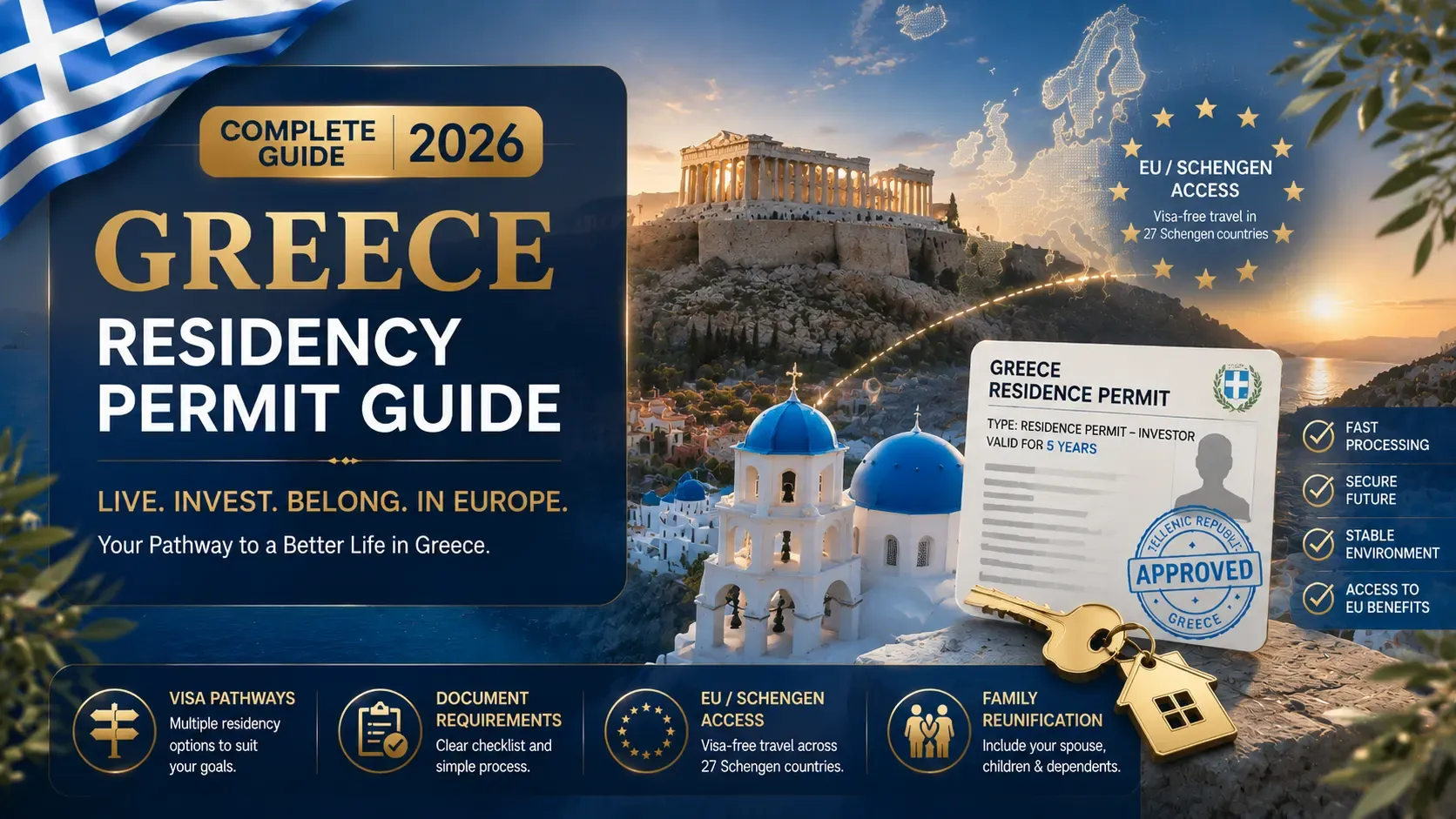
Greece runs one of Europe's most flexible residency systems. Whether you arrive with capital, with a remote salary, with a pension, or with a job offer, there is a clearly defined permit waiting for you. The country has used residency as a strategic lever since the post-2010 recovery, and in 2026 that toolkit is broader than ever — five mainstream pathways, a streamlined biometric card system, and a path to citizenship for those who stay seven years.
This guide covers every active Greek residency permit type, the documents and capital each one demands, the renewal cycle, the ADET biometric card, and the practical steps from application to the moment you can travel Schengen as a Greek resident.
What is a Greece residency permit?
A Greece residency permit is the legal document that allows a non-EU national to live in Greece for longer than 90 days. It is issued by the Greek Ministry of Migration and Asylum after entry on a national long-stay visa (D-visa). The physical card is called the ADET — a biometric residence permit that doubles as Schengen travel authorization for residents.
Greece offers five main residency tracks for third-country nationals: the Golden Visa (investment), the Digital Nomad Visa (remote workers), the Financially Independent Person (FIP) permit (passive income), the work permit (employer-sponsored), and the student permit. Each has its own income or capital threshold, validity period, and renewal cycle. EU and EEA nationals do not need a permit — they register a certificate of residence locally.
The permit is the residency right. It is separate from citizenship, which becomes available after seven continuous years of legal residence under most categories.
Greece Golden Visa — the investment route
The Greece Golden Visa is the country's residency-by-investment programme. Investors who place qualifying capital — most commonly real estate — receive a five-year renewable residence permit covering themselves, their spouse, dependent children, and dependent parents on both sides. There is no minimum stay requirement to renew, which makes it the most popular route for non-resident investors.
Capital thresholds vary by location and asset type. The map matters as much as the number.
| Investment route | Minimum amount | Notes |
|---|---|---|
| Tier 1 zones (Athens center, Thessaloniki center, Mykonos, Santorini) | EUR 800,000 | Min 120 sqm, single property |
| Rest of mainland and islands | EUR 400,000 | Min 120 sqm, single property |
| Commercial-to-residential conversion | EUR 250,000 | Anywhere in Greece |
| Heritage-listed building restoration | EUR 250,000 | Anywhere in Greece |
| Government bonds, mutual funds, time deposits | EUR 500,000+ | Alternative routes available |
Processing takes roughly three months from biometrics to permit issue. Property transfer tax sits at approximately 3.09 percent on top of the purchase price. The permit unlocks Schengen travel — currently 185 visa-free destinations once Greek citizenship is acquired after seven years.
Greece Digital Nomad Visa
The Greek Digital Nomad Visa targets remote employees and freelancers who earn from non-Greek clients. It is a one-year residence permit, renewable for an additional two years. The minimum income threshold is EUR 3,500 per month from foreign sources, increased by 20 percent for a spouse and 15 percent per child. Applicants must hold remote work that does not compete with the local Greek labour market.
The visa carries a tax sweetener: nomads who become Greek tax residents qualify for a 50 percent income tax exemption for the first seven years on Greek-source employment or business income. That single rule has pulled thousands of remote tech workers from London, Berlin, and Amsterdam to Athens, Crete, and the islands since the programme launched.
The application can begin at a Greek consulate abroad or — for nationals already on a tourist stay — through the local immigration office once a national D-visa is converted. Required documents include proof of remote employment, twelve months of bank statements, clean criminal record, private health insurance, and proof of accommodation.
Greece Financially Independent Person (FIP) Visa
The FIP visa is the route for retirees, rentiers, and high-net-worth individuals who do not need to work. It does not require investment, employment, or remote contracts — only proof of stable passive income from outside Greece. The minimum income is EUR 3,500 per month (raised from EUR 2,000 under Law 5038/2023, in force from January 2024), plus 20 percent for a spouse and 15 percent per dependent child. The FIP requires 183 days physical presence per year for renewal — unlike the Golden Visa which has no minimum stay requirement.
The initial permit is valid for two years and renewable for three-year cycles thereafter. FIP holders cannot perform paid work in Greece — the permit is strictly residence-based. Pension income, rental income, dividend streams, and investment returns all qualify, provided they are documented and traceable. After seven years on this status, citizenship becomes available subject to the standard language and integration tests.
Combined with Greece's flat tax options — including the 7 percent flat tax on foreign pension income and the EUR 100,000 non-dom flat tax for high-net-worth residents — the FIP is one of Europe's most efficient retirement settlement routes.
Greece work permit and student permit
Greek work permits are sponsored by the employer and tied to a labour market test. The employer applies first to the Ministry of Labour for a work authorization, after which the employee applies for a national D-visa abroad. The initial permit lasts one year and is renewable in two-year cycles. Permit categories include dependent employment, seasonal work, intra-corporate transfer, and the EU Blue Card for highly qualified professionals.
The student permit is issued to non-EU nationals enrolled in accredited Greek universities or recognized foundation-year programmes. It is valid for the academic year and renewable annually for the duration of studies. Students can work part-time up to 20 hours per week. Time spent on a student permit counts toward the seven-year citizenship clock at a 50 percent rate.
| Permit type | Initial validity | Renewal cycle | Path to citizenship |
|---|---|---|---|
| Golden Visa | 5 years | 5 years | 7 years legal residence |
| Digital Nomad | 1 year | 2 years | 7 years legal residence |
| FIP | 2 years | 3 years | 7 years legal residence |
| Work permit | 1 year | 2 years | 7 years legal residence |
| Student permit | 1 year | 1 year | Counts at 50 percent |
The ADET biometric residence permit card
The ADET is the physical document Greek residents carry. It is issued by the Ministry of Migration and Asylum after the applicant enters Greece on a D-visa, completes biometric capture (fingerprints and photograph) at the local immigration office, and receives initial approval. The card replaces the older paper booklets and is fully aligned with EU Council Regulation 1030/2002 on uniform residence permit format.
Functionally, the ADET serves three purposes. First, it proves legal residence inside Greece for opening bank accounts, signing leases, registering vehicles, and accessing the AMKA social security number. Second, it allows visa-free travel inside the Schengen Area for up to 90 days in any 180-day rolling window — the same right Schengen citizens enjoy. Third, it functions as official ID for domestic identification purposes.
The ADET card carries the holder's photograph, fingerprints in the chip, full name, date of birth, nationality, permit category, expiry date, and a unique permit number. That number is what you use for the residence permit check on the official Ministry portal.
Greece residency permit renewal — step by step
Renewal must be filed before the existing permit expires — Greek law allows applications to be lodged up to two months before the expiry date. Filing late can trigger fines or, in extreme cases, the loss of accumulated residence time toward citizenship. The process is administrative rather than discretionary: provided the underlying conditions still apply (capital still invested, income still flowing, employment still active), renewal is routine.
The standard renewal flow runs through the Greek Ministry of Migration's online portal, with biometric appointments at the local Aliens and Immigration Department. Required documents typically include the existing permit, valid passport, updated proof of the qualifying basis (property deed, bank statements, employment contract), proof of accommodation, valid health insurance, and tax compliance certificates.
- Compile renewal dossier two to three months before expiry
- Submit application online through the migration portal
- Pay the renewal fee (typically EUR 150 to 1,000 depending on category)
- Attend biometric appointment at local immigration office
- Receive temporary blue paper certificate (valid one year)
- Collect renewed ADET card once printed (typically 6 to 9 months later)
The blue paper certificate is critical. It serves as proof of legal residence during the gap between application and card issuance, and is accepted for Schengen travel alongside the expired ADET card.
Greece residence permit check — verifying status
The Ministry of Migration operates an online portal where applicants can verify the status of any pending or active permit. Required inputs are the application reference number and the applicant's date of birth. The portal returns four states: under review, approved, ready for collection, or rejected. For active permits, the holder can also confirm validity period and renewal eligibility through the same system.
Third-party verification — for landlords, banks, or employers — is handled differently. The verifying party must request the applicant's consent and either inspect the physical ADET card with its embedded chip or use the Ministry's institutional verification channel. Photographing the ADET for transmission is permitted under Greek data protection rules, provided the holder consents.
From permit to passport — the seven-year track
Greek citizenship by naturalization requires seven continuous years of legal residence under most permit categories. Applicants must demonstrate Greek language competency at B1 level, knowledge of Greek history, geography, and political institutions, and integration into Greek civic life. The current Greek passport ranks among the world's strongest, with 185 visa-free or visa-on-arrival destinations.
Time spent on different permits aggregates — five years on a Golden Visa followed by two years on an FIP permit counts as seven continuous years for citizenship purposes, provided there were no significant gaps. Time on student permits counts at 50 percent, and short trips abroad do not break continuity. Greece allows dual citizenship, so applicants do not need to renounce their original nationality.
Ready to apply for the right Greek permit for your situation?
Choosing between Golden Visa, Digital Nomad, FIP, and work routes depends on your capital, income, family structure, and long-term goals.