
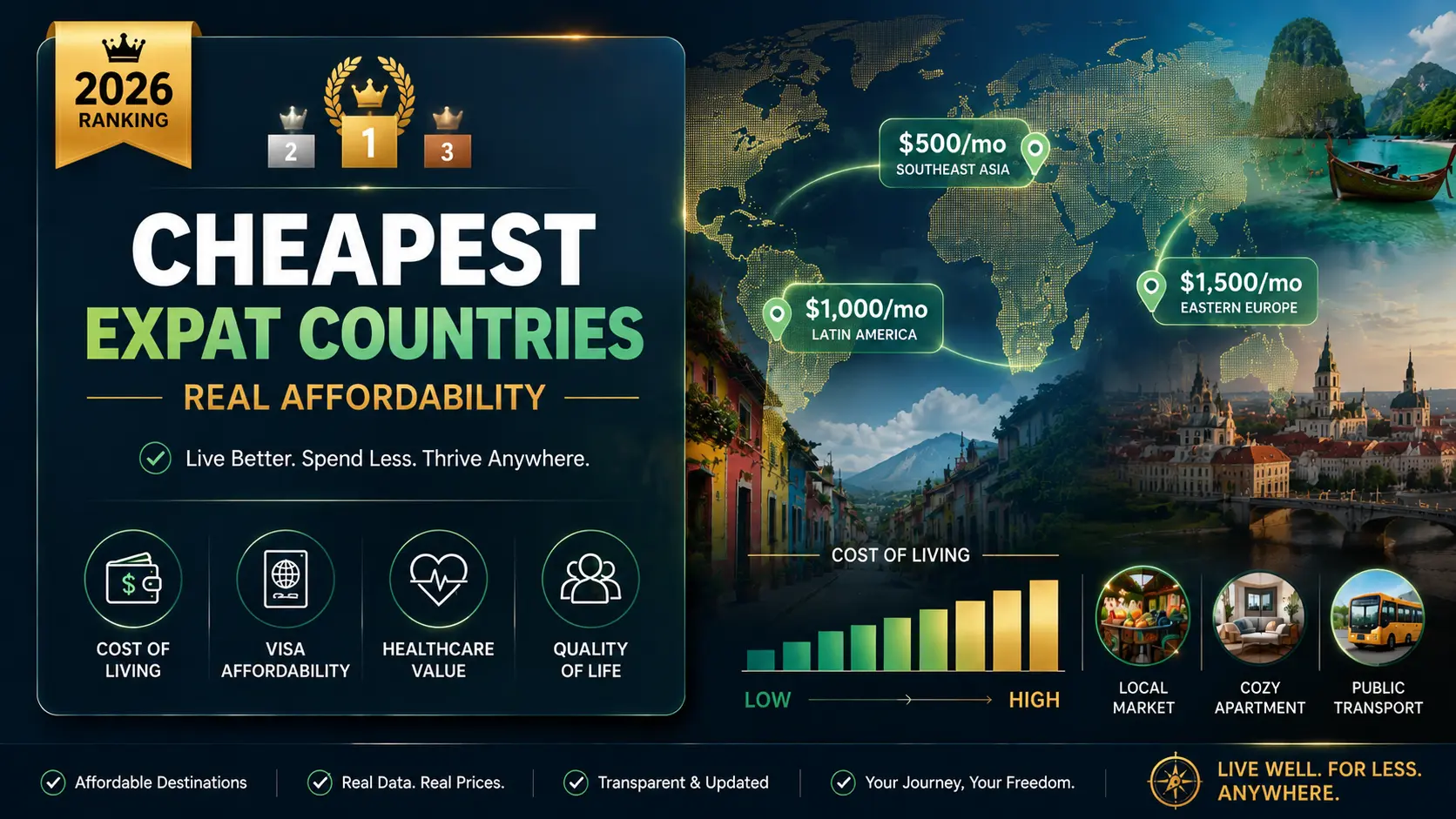
The cheapest expat countries are not always the ones with the lowest grocery bills. Real affordability is a function of three numbers stacked together: the visa or residency cost, the monthly cost of living once you arrive, and the tax bill on whatever income you bring with you. A country can look cheap on a Cost of Living index and still be financially worse than a slightly more expensive option once visa fees, health insurance, and tax exposure are added. This guide ranks the genuinely affordable destinations in 2026 across all three of those numbers.
How to define cheap when you are moving overseas
Many "cheapest country" rankings are written for backpackers and short-stay digital nomads. Those rankings tell you very little if you are actually relocating. A meaningful ranking for expats has to combine four things.
- Entry cost: visa fees, investment thresholds, deposits, and minimum income proofs.
- Monthly cost of living: rent, food, utilities, transport, and household basics for a couple.
- Healthcare and insurance: what comparable expat coverage actually costs.
- Tax position: what you pay locally on foreign pension, salary, dividend, or business income.
Add those four numbers and the rankings shift dramatically. Some Caribbean lifestyle destinations win on tax but lose on cost of imported goods. Saudi Arabia is cheap and tax-free but offers no path to a second passport. Mexico is genuinely affordable but pays you in long-term residency rather than fast EU access. Greece, as we will show, scores in the top three on all four metrics simultaneously, which is why it sits at the top of this list.
Greece: the affordability and EU access combo
Greece is the headline answer for cost-conscious expats who also want European Union residency, healthcare standards, and a clear path to a powerful passport. Outside Athens, Mykonos, and Santorini, prices remain among the lowest in the eurozone.
| Region | Couple monthly budget (EUR) | Notes |
|---|---|---|
| Athens (non-premium) | 1,800-3,000 | Capital city, full services |
| Thessaloniki | 1,500-2,200 | Second city, university hub |
| Crete & Peloponnese | 1,200-2,000 | Coastal towns and inland villages |
| Greek islands (off-season) | 1,000-1,800 | Outside high tourist months |
Restaurant meals run EUR 12 to 25 in mid-range tavernas, expat health insurance from EUR 80 to 150 per month, and property prices outside the premium zones range from EUR 1,500 to 4,000 per square metre. The Tier 3 Greek Golden Visa retains a EUR 250,000 minimum for commercial-to-residency conversions over 120 square metres, which is the lowest entry point of any EU residency-by-investment programme still operating.
The decisive factor is tax. Greece offers a 7% flat tax for 15 years on foreign pension income for retirees who move their tax residence to the country. For a couple with USD 100,000 of pension income, that single rule outweighs almost every other cost-of-living advantage that competing destinations advertise.
Portugal: cheap once you leave Lisbon
Portugal remains affordable, but the picture has changed twice in the last three years. The NHR tax regime ended in 2024 and was replaced by IFICI, which is targeted narrowly at researchers and innovation-economy workers and is not the broad pension-income shelter that NHR was. Real estate was also removed from the Golden Visa in October 2023, leaving only the EUR 500,000 funds investment route.
| Region | Couple monthly budget (EUR) |
|---|---|
| Lisbon | 2,500-3,500 |
| Porto | 1,800-2,800 |
| Algarve | 1,500-2,500 |
| Smaller cities & inland | 1,200-2,000 |
Lisbon is no longer cheap by European standards, but coastal Algarve villages, Porto's outer neighbourhoods, and inland regions like Alentejo and the Centro remain genuinely affordable. Portuguese citizenship now requires 10 years for most applicants; 7 years for EU and CPLP nationals (Nationality Law amendment in force since 19 May 2026 under Lei Orgânica n.º 1/2026 (Diário da República n.º 95/2026, published 18 May 2026); applications submitted before 19 May 2026 retain the prior 5-year rule under transitional provisions). Permanent residency remains 5 years.
Italy: the south is the value play
Northern Italian cities are expensive. Milan and Rome budgets land at EUR 2,500 to 4,000 monthly for a couple and rise quickly in central neighbourhoods. The opposite is true in the south. Puglia, Basilicata, Calabria, and Sicily all support comfortable lifestyles at EUR 1,200 to 2,000 monthly, often in restored masseria or village apartments at fractions of northern pricing.
Italy's investor visa starts at EUR 250,000 for an Italian innovative startup and rises to EUR 2 million for government bonds. The genuinely interesting tool for high-income expats is the flat-tax non-dom regime, now EUR 300,000 per year for new entrants from 1 January 2026 (2026 Budget Law). Family members EUR 50,000 each. Pre-10 August 2024 entrants keep EUR 100,000; entrants between 10 August 2024 and 31 December 2025 keep EUR 200,000. The regime caps Italian tax on all foreign-source income at a fixed annual amount for up to 15 years. That makes Italy the standout option for expats with substantial dividend, royalty, or business income flowing from outside the country.
Mexico: the fastest cheap path for North Americans
Mexico is the most accessible affordable destination for US and Canadian citizens. Permanent residency is available either through proving approximately USD 300,000 in savings (45,850 × UMA 117.31 MXN). Tied to UMA, adjusts annually. or through demonstrating roughly USD 4,300 monthly income (the latter route initially grants four-year temporary residency). Citizenship is reachable after five years.
| Region | Couple monthly budget (USD) |
|---|---|
| Mexico City premium | 2,000-3,000 |
| Guadalajara, Mérida | 1,500-2,200 |
| San Miguel de Allende, Puerto Vallarta | 1,800-2,500 |
| Smaller towns | 1,200-1,800 |
The Mexican passport carries roughly 159 visa-free destinations and gives full mobility across North America under USMCA. Healthcare quality in major cities is high relative to cost, and private expat insurance is materially cheaper than US plans. The trade-off is geographic and political: Mexico does not deliver European mobility, and the safety profile varies sharply by region.
Cyprus: low taxes at moderate cost
Cyprus is not the cheapest country on the list, but its tax architecture pulls it into the top tier of value destinations. Permanent residency is available at a EUR 300,000 property or fund investment. Corporate tax sits at 12.5%, one of the lowest in the European Union, and the non-dom regime exempts dividend and interest income from Cypriot tax for 17 years for qualifying new tax residents.
For an entrepreneur or investor running a business or a portfolio that generates passive income, Cyprus's combination of EU residency, English-language administration, common-law-influenced legal system, and deep tax exemptions often beats nominally cheaper destinations on total after-tax cost. Cost of living for a couple typically runs EUR 1,800 to 2,800 monthly outside Limassol's premium zones.
Caribbean CBI: lifestyle and a passport in months
Five Caribbean countries continue to offer citizenship-by-investment programmes that result in a passport within roughly four to twelve months. None of them are the absolute cheapest places to live day to day, because most goods are imported, but several are competitive on lifestyle cost and all of them deliver a second passport.
| Country | Min CBI investment | Visa-free destinations |
|---|---|---|
| Dominica | USD 200,000 | ~160 |
| Antigua & Barbuda | USD 230,000 | ~164 |
| Grenada | USD 235,000 | ~144 (US E-2 eligible) |
| St Lucia | USD 240,000 | ~156 |
| St Kitts & Nevis | USD 250,000 | ~167 |
Grenada is the unique pick because its citizens qualify for the US E-2 treaty investor visa, an indirect route to long-term US residency that is unavailable through the other four programmes. Important: under the 2022 US AMIGOS Act (signed 23 December 2022 as part of the NDAA FY2023), investors who obtained Grenadian citizenship through CBI must prove three years of genuine domicile (i.e., actually living) in Grenada before applying for the E-2 visa. This is not an immediate route. None of the Caribbean nations levy tax on worldwide income for non-resident citizens, so a passport here often functions as a tax-neutral second nationality without requiring relocation.
Note: as of 21 January 2026, the US suspended immigrant visa processing for nationals of 75 countries — including all five Caribbean CBI nations (Antigua, Dominica, Grenada, St Kitts, St Lucia). Non-immigrant visas (tourism, business, E-2) remain available. Investors with US immigration plans should seek separate US legal advice.
Saudi Arabia: cheap, tax-free, but no passport
Saudi Arabia's Premium Residency programme costs roughly USD 213,000 (SAR 800,000) for the permanent option and is processed in three to six months. Saudi Premium Residency has two options: SAR 800,000 one-time permanent OR an annual SAR 100,000 renewable option (up to 5 years). There is no personal income tax in the Kingdom, the cost of living is low outside Riyadh and Jeddah's premium districts, and the residency carries the right to own property and conduct business without a local sponsor.
Spain, UK, Malta: closed and not cheap
Three programmes that used to feature on affordability lists are no longer available. Spain's Golden Visa ended in April 2025. The UK's Tier 1 Investor visa closed in February 2022. Malta's MEIN citizenship programme was permanently ended (not suspended) following the ECJ ruling of 29 April 2025 (Case C-181/23). Malta enacted Act XXI of 2025, in force 24 July 2025, repealing all CBI provisions and replacing them with a discretionary merit-based naturalization route. Malta's MPRP residency programme is separate and still active. None of these should appear in any 2026 ranking of cheap expat options. Spain in particular still publishes lifestyle articles claiming a path that no longer exists, so verify before acting on older content.
Cheapest expat health insurance in 2026
Health coverage is the single most volatile line item in expat budgets. International private medical insurance for a healthy couple aged 50 to 65 typically lands in the following ranges in 2026.
| Destination type | Monthly couple premium (USD) |
|---|---|
| Greece, Portugal, Italy (local plans) | 160-300 |
| Mexico (local private) | 180-350 |
| Cyprus (local plans) | 200-400 |
| Caribbean (international plans) | 400-800 |
| Global plans (any destination) | 500-1,200 |
Local plans in Greece, Portugal, Italy, and Mexico are dramatically cheaper than international expat insurance because they piggyback on already-affordable national healthcare costs. For most retirees who plan to stay primarily in one country, a local plan plus a small international top-up rider is the cheapest coverage configuration.
Cheapest countries for digital nomads
Digital nomads have a different optimisation problem from retirees. They typically want short-stay flexibility, fast internet, low rent, and either zero local tax exposure or a short qualifying period before triggering tax residency. Greece, Portugal, and Mexico all offer formal digital nomad visas with sub-EUR/USD 4,000 monthly income thresholds, low fees, and renewable terms.
Of the three, Greece is the strongest combined value play in 2026. The Greek digital nomad visa offers a 50% tax exemption on Greek-source employment income for seven years, the cost of living in regional cities and islands remains the lowest of the three, and the same residency status can be transitioned into long-term residency and eventual EU citizenship via the seven-year naturalisation route.
Cheapest countries for US citizens to retire
US retirees face a specific stack of constraints. Most carry significant 401(k) and IRA balances, receive Social Security, and remain subject to US worldwide tax obligations regardless of where they live. The cheapest destinations that work cleanly with that profile are Mexico, Greece, Portugal, and Italy.
- Mexico: proximity, USMCA mobility, USD 4,300 monthly income proof, and a low day-to-day cost base.
- Greece: 7% flat foreign-pension tax for 15 years, EU healthcare, and the lowest qualifying income test of the European options.
- Portugal: still cheap outside Lisbon, but the loss of NHR removes the strongest tax advantage.
- Italy (south): The flat-tax non-dom regime is EUR 300,000/year for new entrants from 1 January 2026 (pre-10 August 2024 entrants keep EUR 100,000; entrants 10 Aug 2024 – 31 Dec 2025 keep EUR 200,000). A strong fit for retirees with significant non-Social-Security foreign income.
Want a personalised affordability ranking?
We model visa cost, cost of living, healthcare, and tax exposure against your actual income profile.
Putting the rankings together
The single best general-purpose answer in 2026 is Greece, because it is the only destination on this list that pairs sub-EUR 2,000 monthly couple budgets with full EU residency, low-cost healthcare, an active EUR 250,000 entry-tier residency-by-investment route, and a 7% flat retirement tax for 15 years. Mexico wins on speed and proximity for North Americans. Italy's south wins for high-income retirees who can take advantage of the flat-tax non-dom regime. The Caribbean wins for those who want a passport without relocating. Saudi Arabia wins for tax-free Gulf operational presence. The right answer for any individual depends entirely on the income, mobility, and citizenship goals being optimised.
This article is for informational purposes only and does not constitute legal, tax, financial, or immigration advice. Cost-of-living estimates, visa thresholds, and tax rules can change quickly. Always confirm current requirements with licensed local counsel and a qualified cross-border tax advisor before relocating.